Crater Lake To Stanley, Day 14 : Discomfort

I’m riding up a long shallow hill through the wilderness north of Lowman, with my iPod playing and a juice bottle on my lap. On my right is a collection of large houses, set back into the woods. They have a large-windowed, all-lumber, sloping-corrugated-roof design that is common for the northwestern United States. Outside most of them I see evidence of children – swing sets, trampolines, bikes and tricycles – and a few times I see the actual children, walking along trails by the road or running around in the trees down by the river.

More than a few times I’ve heard people say that the near-wilderness like this is “a great place to raise kids”. I’ve read countless descriptions of an idealized life for a nuclear family, running around a big house in the woods, with the nearest town half an hour away, and the rugged hillsides being a kind of extended playground where children can grow up with endless fresh air and exercise, without concern for those nasty kidnappers and sexual deviant neighbors and drug dealers and gang members that peek out from behind every lamp post in the cities.

And now I’m out here looking at those big houses, and I’ve been bicycling through the near-wilderness for a couple of days. Perhaps these are merely vacation homes, and the kids stay here for a couple of months per year at the most. It would be great to have enough money for that option. Better yet perhaps these are retirement homes, owned by older members of an extended clan, and the grandkids visit for the summer while the seniors get to walk around and hang out all year.

But as the houses scroll slowly along, I decide that’s probably too optimistic. Along with the children’s toys, the houses are also surrounded by the tools of modern adults trying to make a living. Trucks, workshops, half-assembled machinery, mottled gardens, heaps of firewood. People aren’t just playing here. Their kids probably don’t just spend the summer here, either. Which means they bus half an hour into town for school, and for the holidays they go into the city, instead of out.

Some of my favorite childhood memories are based on the way I grew up in the woods, with the animals and the garden space and the comfortable privacy. But the thing about the place I grew up in, that’s different from out here, is that I had the appearance of wilderness without actually being lost in it. I was really just a few miles away from a mighty center of industry, and a collection of well funded universities. All around me, the threads of a much larger world converged.

As an adult, I now realize that my life as a teenager was greatly enhanced by this larger environment. This has introduced a chord of doubt into the chorus of voices around me preaching for an idealized family life out in the woods. And the kids I see wandering around in the small towns and along the roads of these outpost houses are reinforcing that doubt. I know there are things going on out here; plenty of things. But how much of them are of value to teenagers? How many of them help to mitigate the endless hunger for variety and intrigue that teenage life is all about? It seems almost like an act of greed, to move or start a family out here, for the fun of raising small children in a wilderness setting, when my personal enjoyment of their idealized early youth carries over into a teenage life for them of narrowed perspectives and stifling boredom. Besides: The city may have gangs and cocaine, but the country has megachurches and methamphetamine.

Even if they didn’t know what they were missing, I would know. The most I could hope for as a way of introducing them to that world would be to send them off to college, and then, why in the hell would they want to come back here afterwards, except for lack of better options?

Sure, I know, I’m keeping my perspective too narrow. Millions of people raise kids far from affluent cities. Their lives aren’t unhappy, they’re just different. Mostly I just want something of equal or better quality – as I judge it – for my children as I had when I was growing up. But I am not a member of the “1%” clan – the 1% of living people that owns 40% of the wold’s wealth. Instead I’m a member of the “everybody else” clan, and here in America at least, we’ve spent the last 30 years sliding slowly down the sides of the pyramid. My family had a four-bedroom house on the perfect edge of the wilderness but we lost it. Since then, its new owner has also nearly lost it, as divorce and the corrupted economy pounded on her too. Our old neighbors have all taken similar beatings. The lucky ones – the older ones – have their homes paid for but have seen their diversified savings accumulated over the last ten years slowly dissolve. I don’t know where we’re all going, but I can tell you this much. The nuclear family is not the appealing ideal it once was. It seems too easily crushed, in a world where both parents need to work full time.

So whatever I’m looking for – if I find it – it probably won’t look like this; like these little houses stuck in the woods. They look like tar pits to me now; places fit for slowly drowning in. Then again, the price tags on urban properties are ludicrous, and are tar pits in their own right.

Lots to think about, as I pedal up this road.
https://farm9.staticflickr.com/8507/8530272118_72e906d98b_b.jpg
https://www.flickr.com/photos/57897385@N07/8530272118/
https://farm9.staticflickr.com/8507/8530272118_72e906d98b_s.jpg
2009_07_23-09_33_18-IMG_1127

Crater Lake To Stanley, Day 13 : Discomfort

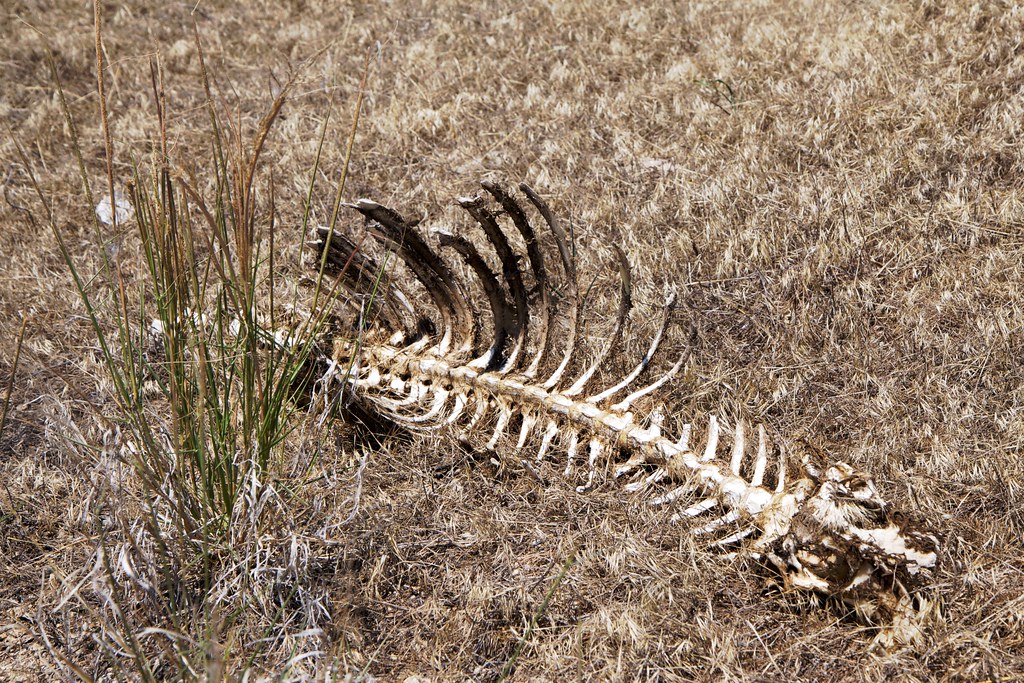
I listen to “A study in Emerald”, and note with amusement that I recognize the names of the elder gods from the HP Lovecraft radio plays I was just listening to the other day. As the character we presume to be Watson is introducing himself, I pass by a heap of bones in the field to the side of the road, and stop to grab a photo of it.

https://farm9.staticflickr.com/8099/8529158139_abc98652d1_b.jpg
https://www.flickr.com/photos/57897385@N07/8529158139/
https://farm9.staticflickr.com/8099/8529158139_abc98652d1_s.jpg
2009_07_22-12_27_08-IMG_1089

After several hours of uneventful climbing, I arrive on a plateau. The towns of Garden Valley and Crouch are heaped together here. I see a sign advertising an RV park in Crouch, but decide to keep going since it is only late afternoon and I’m feeling good. Then the road tilts downhill, and the terrain speeds by.

I stop at a campground to use the restroom, and notice a sign saying “no vacancy”, and another sign saying that the camping fee is ten bucks, cash only. Even if there were a space available, I don’t have any cash. I ride on, and the road keeps dropping. Late afternoon turns to evening. I crane my neck to spot any more campgrounds, but there are none. Now I’m getting a bit worried.

The road bottoms out, then begins to sway in long heavy arcs, pressed against rocky cliffs on my left and a chattering river on my right. The cars thin out to a few, and then to very few. The houses stop. Now it’s just me on an empty road, and it’s dark. Then I encounter a hill.

I know this hill is different from the others because, way in the distance and at least a thousand feet up, I can see the headlights of an approaching car. As I pedal I can watch the headlights curve slowly around towards me, as the car follows the road, down along an inside curve against the mountain, carved by the massive bend in the river below. I count under my breath and it takes almost an entire minute for the car to reach me. Overwhelmed, I stop at a narrow turnout and devour the last of my dry food – a small bag of corn chips. All I have now is part of a green squash, and a little water. “Well, crap. I’ll probably have to sleep in the woods or something tonight. Except that there aren’t any woods here, just cliffs and water. So I need to keep going.”

I’m getting very tired, and despite my gloves, shirt, sweater, and sweatpants, some of the cold is creeping in. I make frequent stops but even when I recover my breath completely, I can’t go 50 yards without breathing hard again on this damned slope. Then, about 3/4 of the way up, a strong headwind starts trying to push me back down the hill. I grit my teeth and start cursing at the wind, calling it every foul name that comes to my dazed mind. I make insulting faces at it, half from anger and half from a desire to work some heat back into the muscles of my face. Finally, at long last, I get to the top of the hill. “Glad that’s over with,” I shout. “Now, this [expletive] road better not just [expletive] go straight back down again.” I pause to take a picture of the stars with my camera, but I’m too dazed to do it properly and the shot is badly exposed. Then I pack the camera up and ride on …

… And the road shoots straight back down the mountainside again. I curse a blue streak all the way.

There is some good news: Now instead of a cliff, there is actual forest around me. After a mile or so, I see a sign for the Pine Flats Campground on my right. I turn onto the driveway and shoot down a very steep but well-paved road, then begin pedaling slowly around the campground looking for an open space. … And there isn’t a single one. The spaces that aren’t currently occupied all have little slips of paper pinned to the number posts, indicating that they are reserved for the next morning. Bah. I could try and stealth-camp in one of these sites, but I’d have to get up at 4:30 in the morning to repack all my gear and sneak out before the ranger comes trolling around. That would get me five hours of poor sleep at the most, considering how long it takes to manage my tent in darkness.

Disappointed and even more tired, I bike slowly up the steep entrance, and get back on the road. My mind wanders for a while. The cold is getting to my feet. They’ve spent too long clipped to pedals and tilted uphill. I detach my right foot to shake it out, then forget to steer, then overcorrect to avoid hitting the guardrail, then the bike pitches and I fall down. I pick it up and slowly reposition myself and pedal on. 40 yards later I attempt to adjust the hem of my sweater and nearly fall down again. “I can’t just keep riding forever,” I tell myself. “Maybe I’ll find something in the town of Lowman.”

Turns out Lowman is only a few miles away. I pedal up a relatively shallow hill and arrive at the single T-junction that defines the town. Down the road to my right is a low bridge passing over a river, with a lodge and cabins on the other side. There are some lights on but I doubt anyone is awake, since it’s near midnight. I cruise over to the lodge and around the parking lot to the back entrance, and find an open bar. I park and knock on the inside of the door and yell, “Hello?”

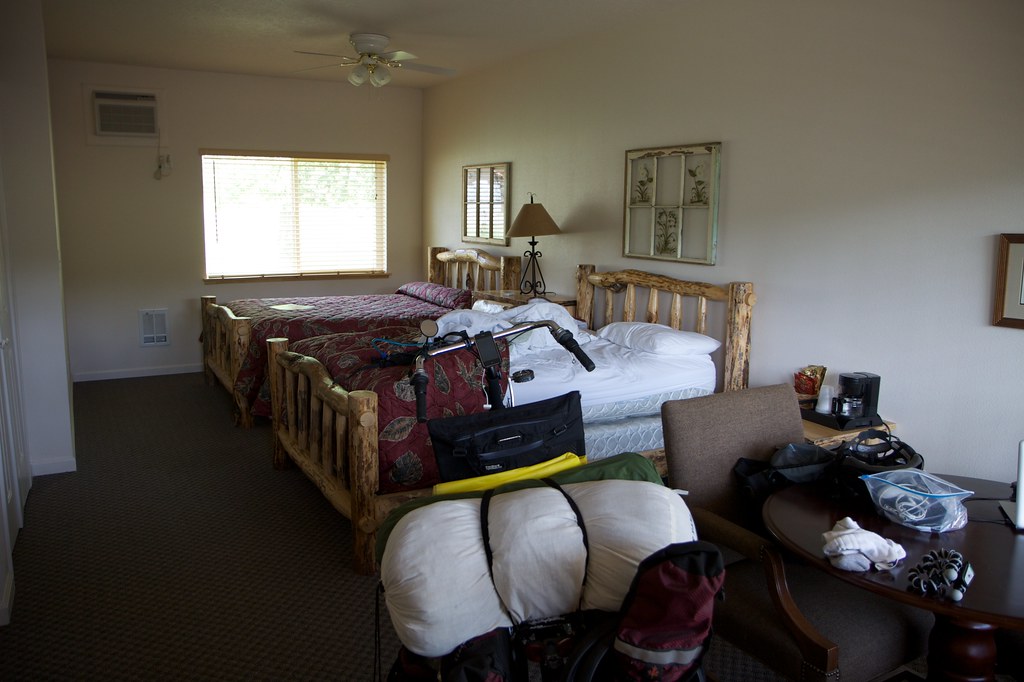
A woman walks out of a dining area holding a cleaning rag, so I introduce myself. Turns out she is one of the managers, and was just a few minutes away from closing up the bar and going home. I negotiate to stay in one of the cabins for a reduced rate, pick up my key, and push the bike around to my assigned cabin, for some badly needed sleep. I’ve gone 70 miles and climbed 3500 feet today.

Crater Lake To Stanley, Day 12 : Discomfort

Between Fruitland and Emmett I ride past three very large billboards, bleached by the sunlight and dusty from the fields. Each one shows a scary “public service” warning about methamphetamine. The most graphic one says “You won’t need to worry about getting lipstick on your teeth any more”, with a photo of a girl’s mouth, overflowing with destroyed teeth.

I roll down into the town of Emmett and find a motel without trouble. Eighteen rooms, and three are in use. I get #14, which would be #13 except that they skipped #13 in the layout.

The people here on the road look a lot dirtier and more beat up than in Oregon. The Oregon enthusiasm and politeness is starting to wear off too. Most people pass without waving, or stare impolitely. I keep seeing cars driven by distraught looking young kids. I pity them.

Crater Lake To Stanley, Day 10 : Discomfort

I get up and load my bike, and before I leave town I go poking around the RV park again, to get a better look at the colony of cats. Some of them are dirty and clearly need homes. But it’s not like I can just pick one up and stuff it in my luggage. And they’re half-feral at least already – it may be too late to train them.

https://farm9.staticflickr.com/8225/8529156493_6781b17ba3_b.jpg
https://www.flickr.com/photos/57897385@N07/8529156493/
https://farm9.staticflickr.com/8225/8529156493_6781b17ba3_s.jpg
2009_07_19-08_54_30-IMG_1065

Crater Lake To Stanley, Day 9 : Discomfort

Around 3:00am I wake up hearing the sound of animals roving around outside – raccoons perhaps. I dismiss the noise, and turn on my back, and fall asleep again.

About an hour later I hear an angry snapping sound close at hand, and I open my eyes, still mostly asleep, and see light flashing indistinctly around me. Freaked out, disoriented from my weird dreams, I sit up and claw savagely at the air in front of my face, instinctively trying to pre-emptively attack whatever is about to kill me.

Then I sit all the way up, eyes straining, and all I see is the pinpoint of light on the side of the power adapter, plugged into my laptop. As I watch it, it turns from orange to green, indicating that it attempted to charge, but then found that the battery was full.

Puzzled by this, but also reassured by the mundanity of it, I remember where I am and who I am, breathe calmly for a while, and then fall back asleep. It’s not until morning, after I’m back on my bike and out on the road, that I realize I was probably awakened by the noise of a temporary power failure caused by crappy wiring. I woke up just in time for the power to return, and for my laptop to attempt another charge.

The territory is beautiful, but as I pedal through it, for eight hours, I am endlessly blasted by a headwind — a punishingly dry one. Every downhill slope feels flat; every hill feels like a hot brick wall. My gloves and kerchief and sweater dry out, and I slurp my way through my lemonade cup, then through one canteen, then through the other, then begin working on my water sack, which is already warm.

Five hours into the ride, I stop the bike and blunder down to the river, to soak my arms and hands. I have to stomp and hack my way through a gauntlet of weeds, and when I get to the river, the banks are narrow and the water is moving fast. I dunk my shoes and my hands, and splash my shirt liberally. When I stumble back up to the road, I discover that a woman has parked her car at the turnout fifty feet away. She walks up to me and asks how she can get to the river, since she’s thirsty too, but I warn her against it, then wish her well and pedal away.

If she has no water, I am not interested in conversation.

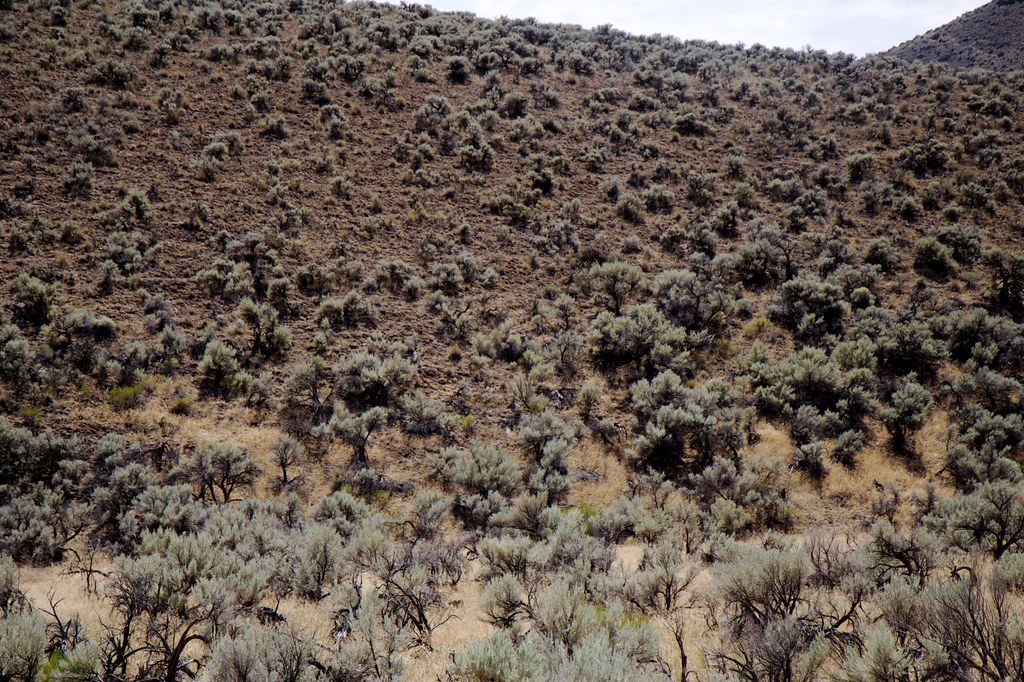
Two hours later I run out of water entirely. The water bag is totally flat. Half an hour later I am thirsty again, and my sleeves and bandanna have dried out. I stop and gaze longingly at the river, still flowing past me with its precarious banks. There’s just no way to get down to it without falling in, and I’d probably be carried a long way before I could drag myself out again. The hills on either side of me are even less hospitable. They’re covered with dry bushes, packed together and reaching up like the clawed hands of the undead, eager to tear at the living.

https://farm9.staticflickr.com/8093/8530266052_2ba9ced90b_b.jpg
https://www.flickr.com/photos/57897385@N07/8530266052/
https://farm9.staticflickr.com/8093/8530266052_2ba9ced90b_s.jpg
2009_07_18-14_06_32-IMG_0991

“Glad I don’t have to walk through that crap,” I mutter, and pedal on. I’m getting a bit worried. I packed as much water as my containers would allow, and it still wasn’t enough to get me past this canyon.

I do eventually find some water, but the ride down out of the mountains leaves me exhausted, and I still have to cross a valley to get to the next town. I can see on my GPS that I need to go down one long stretch of road, then turn northeast, then go down another long stretch of road, and then I’m done for the day. I set an audiobook playing, and concentrate on spinning the pedals, and I make pretty good time until I get to the bend in the road, and then that terrible headwind returns.

It batters me from the left side in irregular bursts, causing me to weave all over the narrow shoulder. The fields across the highway are fallow, and the wind gathers up long rolling tubes of grit and dust, then pushes them over the road at me. Sometimes I can see these waves approaching and brace for them, squinting my eyes and holding my breath, but usually the evening light is too dim for me to make them out. The sun has already set, and the sky is a white blanket of gloom, growing dimmer, but not dark enough to make my headlight useful, and every couple minutes the wind spits raindrops at me, as if to say “Don’t complain, I can easily make it worse.”

Just around the time my GPS indicates I am halfway down the road, the headwind changes course and starts blowing directly in my face. There’s less grit this way, but now it’s against my pedaling, and I’m forced to slow down from 10 miles per hour to 6. I become so frustrated with the wind that I began yelling at it. “Yooouuuuuu ssssuuuuuuuuuuucccckk!!!! Arrrrrrrrrrggghhh!!! Get oouuuuuuuutt of myyy fffaaaaaacceee!!!! ARRRRRGGGH!!” Each time a car passes me in the lane, I swerve out into the road so I can ride in the draft, for the few seconds it remains. It’s risky but I don’t care at this point.

A full hour later I arrive in the town of Vale, exhausted, starving, and coated in grit. Luckily a cheap hotel and a decent restaurant are still open.