With lots of downtime in Höfn, one of the things I did was try to settle the romantic dilemma I’d blundered into a few weeks back. I was out of the highlands and there was no barrier to talking with my new friend, but I struggled with whether I should.
Eventually I wrote her a series of messages:
“So, I’ve been thinking. Lots of space and time to think, out on this weird island. It was fun doing that Zoom meeting with you. Intriguing to connect the face and movement with the thoughts and dialogue before. But I it’s no substitute for a face-to-face meeting.”
“Our physical distance is probably not going to change any time soon. If I was back home, I’d be putting together some kind of invitation for a picnic with you in a sunny park, because you’re very worth exploring. Someone as nifty as you deserves full attention. But I’m not there, I’m here, enacting a travel plan whose wheels I set in motion well before I knew you existed.”
“So, a real chemistry-testing date would be a long time coming. And if you’re newly dating, like I’ve been before, you might be feeling what I often do, which is a sense of overwhelming choice. There are so many different kinds of people! Personalities to bounce off, fun activities to try that your ex didn’t like, and so on! I imagine you could fill your dance card from 9:00am to midnight every day and still never get the whole variety. And given that … it doesn’t make sense to focus on someone so far away. One only has so much energy for these things.”
“I’m not saying I don’t enjoy corresponding with you – I very much do – but being limited to correspondence for such a long time might eventually get more frustrating than fun, and create weird expectations. I don’t want our connection to suffer that fate, but there aren’t any good choices. I think the only choice I have is to suggest that we pause things until I get back. I’m not declaring it quite yet, but the idea has been rolling around in my head for a few days.”
“How do you feel about all this?”
Ten minutes later I got a reply:
“That sounds right to me. I really like messaging with you but I am also actually trying to explore new possibilities right now. And we can’t progress beyond messaging so it makes sense to step back while that’s the case. I’m open to being pen pals in the meantime. I’m interested in your ongoing travels!”
And that’s the way it settled. I knew that stepping back meant drifting away from her, but it was the healthier choice. And better to make it deliberately than just let things fade into nervous silence on one end or the other.
Well, based on that list, the key factor in survivability is the ratio of sheep to people. The more sheep per capita, the better. But I think it’s praa-aa-a-aaa-aaabably more complicated than that…
That report has some really questionable ground rules. For one, it deliberately excludes any factors that might arise from a collapse of external supplies of fuels and materials to these places.
I’m sure you’re aware that Iceland is extremely reliant on industrial-scale shipping to bring in everything from fuel to light bulbs to nails. New Zealand to a similar, but lesser, degree.
But sure, go to Iceland to weather the apocalypse… And remain here, as the airlines and ports shut down, and no one in the rest of the wold bothers to restart them because tourism and banking are dead. Life will not be very comfortable, and probably not very long. Reykjavik will have to depopulate, after a brief period when the trucks burn through their fuel reserves, and then almost all of those people will move out across the landscape, starving as they go, chasing sheep around the highlands.
Geothermal heat is great, when you’ve got time to spend indoors. Not any more. Back to intensive farming, for everyone, as everyone gives a solid try at producing a years’ worth of food in weak sunlight and thoroughly eroded soil. The sheep and goats won’t breed fast enough, and the cattle are too hard on the land so they’ll be consumed almost instantly. The remnants of humanity will go back to cutting grass with horses, and watch as first-world comfort folds in on itself.
It’ll all be truly over when a water pump fails in a storm one too many times and the engineers discover they’ve run entirely out of bolts, and there is nothing anywhere on the island capable of generating temperature hot enough to reforge steel unless you try some truly daring metalwork in the midst of a volcanic eruption.
Before that happens you might try sailing away, except the Vikings already cut down all the trees large enough to build longboats.
Perhaps the moss is edible?
Frankly, in terms of short and long-term survival, my money’s on Texas. They have their own long-term supplies of fertilizer and fuel, the panhandle is extremely productive in terms of crops and cattle, their infrastructure is not nearly as abused by the weather as elsewhere, and (this is the important bit)…
… they are armed to the teeth.
Question
Since you’re hanging around in one place, have you made any new observations about the locals?
Answer
To be honest, no. In public areas the tourists tend to outnumber the locals by a big margin most of the time.
I’m sitting here at a service station that has a cafeteria and electrical sockets, getting some work done. Out the window I can see a car-washing area: Three parking spaces with spray hoses coiled up next to them. There’s a woman there with her 2020-ish Ford F-150 — the kind with the short-ass bed.
I’ve been watching her for a while. She rinsed her car, then applied some kind of spray-on cleaner, then applied a layer of soap with a scrub brush all around it, even climbing into the bed to get the roof, and crawling under to get beneath. Then she did another thorough rinse with the hose, then walked all around the car with two different spray bottles, spraying all the panels and windows.
Then she removed all the floor mats, sprayed them down, soaped them, scrubbed them, sprayed them again, and hit them with the bottles. Then she went over the mirrors and lights on the car with another sponge and soap. Then another full rinse. Then she got out a spraying brush on a broom handle, and scrubbed the rims, including all around the road-facing surface of the tires.
Then she climbed in the back and scrubbed the inside of the tailgate with a rag. She did not rush, and between intervals of writing code I looked up and looked at the clock, and noted that the whole routine took over two hours.
I couldn’t imagine any service station in America tolerating someone who wanted to use their water and parking space for two hours to completely hand-wash their truck. And from my point of view, the truck was already pretty clean when she started. So, was this a tourist being extra-super-cafeful about returning a rental vehicle in good shape? Or was this a local, doing a once-a-year detailing of their workhorse?
I’m no stranger to seemingly wasted time over-doing something. My bicycle is proof of that: I’ve put hours of obsession into every tiny component and piece of luggage on it. On the other hand, I can see it from here, sitting in my service station booth, and the frame is spattered with mud and caked grease, the handlebars are scarred, and some of the stickers are peeling off. And I don’t really care. It’s mostly aluminum, so it’s not like it’s going to rust.
Perhaps I’m seeing an example of Icelanders “taking care of their things” in a more Scandinavian way than their cavalier American counterparts. And perhaps it’s no surprise that, being an American, I’m on the side of the Americans in this case: It’s a damn truck. It’s designed to get knocked around and still last 40 years with standard maintenance; just don’t store it in the snow. The only thing you’re doing by using a hundred gallons of fresh water to wash the dirt off – and it rains all the time in Iceland by the way – is performing cleanliness to a local social standard.
But again: Tourist or local? I didn’t march outside to ask. So, I may not have learned anything here.
I did see this sticker on the bathroom door. I think it counts as local color:
“EMPLOYEES MUST CARVE SLAYER INTO FOREARM BEFORE RETURNING TO WORK.”
Question
What would you do for a living if there were no computers? Like, nothing more complicated than a pocket calculator? What would you do for fun? How would you socialize?
Answer
For fun, I would probably keep riding my bike, but regress to a tape collection and a bookshelf, and end up socializing a lot more in cafes.
I like to write, but if I was reduced to punching a typewriter and shopping my work around to publishers to find some kind of audience, I confess I’d probably just give it up for the most part. I don’t have the chops to make it in the print world. The vast majority of my words would become a rambling paper memoir crammed into binders on a shelf in my garage, read by probably one or two people on the planet at best, fulfilling their main purpose of giving me some way to complete my own thoughts by externalizing them. I really do like nailing down a thought. Perhaps being deprived of electronic transmission would force me to confront just how self-serving my writing habits are.
It’s a funny idea: Whether social media, blogging, or whatever variation you like, the possibility that our work is visible to some random anonymous visitor tossed our way by a search engine lends it a sense of legitimacy that we embrace at the subconscious level and don’t want to think about. I mean, if you spend two days composing a very thoughtful essay about something and post it, only to have the algorithm utterly ignore it, haven’t you really just spent two days muttering to yourself, facing a blank wall, and communicated with no one? Isn’t that appallingly dysfunctional? The vague promise of random future eyeballs prevents you from asking the question. It may even prevent you from doing something more socially fulfilling.
So, I don’t know. I do write these things for my own satisfaction. I need good external memory in words and images or I think I’d forget almost everything concrete, at this point — and I don’t want to forget. It’s something to do with my brain. I struggled with this as a kid and I struggle with it more each year. If computers vanished, this would be a lot harder. Same with photography, and music, and various methods of communication.
Perhaps I’d go back to writing people letters, in actual envelopes with stamps and plant cuttings and stuff in them? Not so bad…
The big issue in my case would be, how do I make a living? I’d probably decide to re-train as a schoolteacher, like my parents. It would take years but I’d enjoy the journey. And heck, I probably already have enough weird facts in my head to assemble a few lesson plans.
I bet the key to the other door opens this one too.
For fire safety there’s a key behind some glass that opens a back door, and that passes through a storage room that also contains spare keys. You can see them through the keyhole! But, should you break the glass? That seems wasteful.
You keep looking around. At the top of some stairs you find another locked door that leads to the upper story of the house, where the owner lives. When you look in the keyhole, you notice it’s dark. It appears that someone has left a key in this door, on the other side.
You also notice that the faceplate over the keyhole only has one screw in it. Has someone taken it apart before you? You don’t have a lot of possessions to work with, but you poke around the laundry room and find a dull knife. It’s just enough to turn the remaining screw.
It’s also enough to turn the entire locking assembly once you get the faceplate off. You do so, and hear a loud “clunk” as the lock disengages. You open the door…
… and discover that the owner has left a complete set of keys to the entire house, including all the rooms, hanging in the lock on the other side of the door.
You unlock your own room, fetch your key, then place the keyring back where you found it, and screw the faceplate back in.
Long story short: It took about two weeks for the new tire to arrive. That meant two weeks in Höfn, rambling around town, doing remote work, and trying every restaurant and snack shop at least once. Not a bad life, though my feet were itchy the whole time.
Parked outside in plain view, with gear on it. That’s security in a small Iceland town.
When the AirBnB stay was done I grabbed a patch of grass at the local campsite and paid a few days in advance. I had plenty of work to do but it was too cold to sit outdoors with the laptop, so I rotated between a couple of cafes, a gas station dining area, and the common area of the campground.
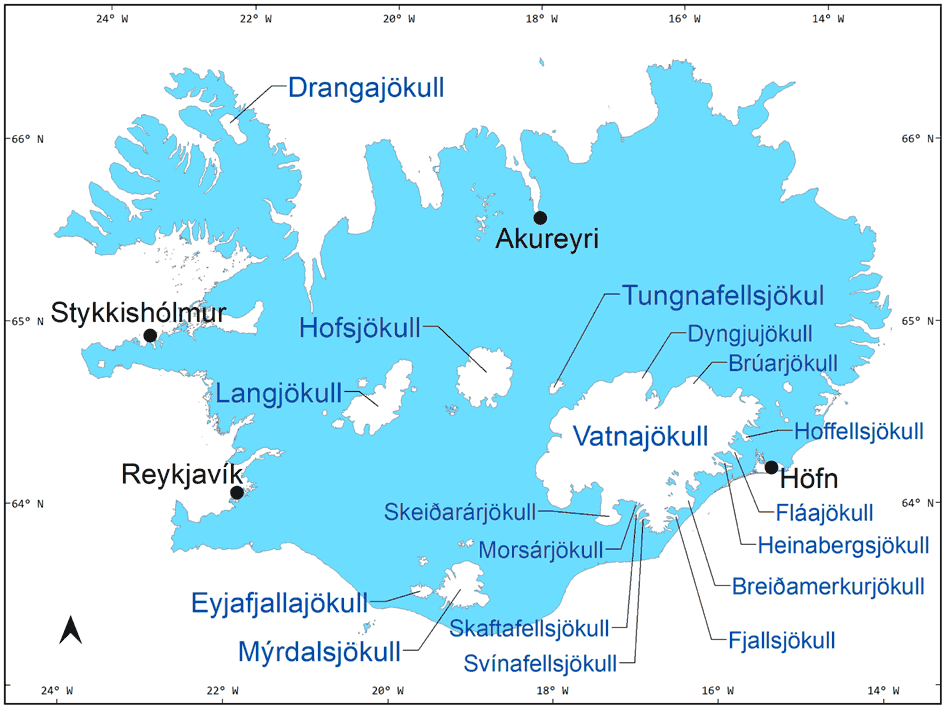
As an aside, while trying to figure out the name of that glacier, I found it was actually pretty hard to find a modern map with enough labels on it. I eventually dug one out of a scientific paper named “Non-surface mass balance of glaciers in Iceland“:
One of the retaining walls along the main street had been turned into an art gallery by local students. By the end of the second week I knew them all. The old dude in the boat was my favorite.
Most artctic terns get to Iceland by flying. Some pay a boatman.
No matter how many times you wash your sweats, you can’t get highway tar out!
Unfortunately, no amount of washing will get highway tar out of sweatpants. My frustration inspired a short poem:
Tenth day of cycling The stench hits you like a truck Time for sink laundry
Hot highway blowout Sitting down to fix the flat Ass covered in tar
Hey bicycle guy Looks like you pooped fireworks Sink laundry again
I had a pair of regular pants that I was wearing around town, but when I got back on the road I would have to wear those revolting sweatpants again. I consoled myself during the endless work hours with snacks:
Höfn is a fine town and I have nothing against it, but the sensation of valuable travel days slipping away made the time I spent there kind of unpleasant. The day I’d arrived, I got in touch with the postal depot in Reykjavík, and in the back-and-forth with them over the two weeks I learned that my package had taken only three days to travel 6000 miles and arrive in Iceland, and the additional twelve days got consumed by the customs inspection and the 280-mile (450km) journey around the country to get to Höfn. It was frustrating, but I knew I had no alternative to waiting.
There was only one 20-inch bike tire in the entire country, and it was in a box headed my way.
By the time I had the bike loaded again, the Italians were just starting to wake up and populate the kitchen. I headed for the restaurant from yesterday and chomped an open-faced sandwich.
Tasty somewhat traditional breakfast at the museum.
Tasty somewhat traditional breakfast at the museum.
I had 40 miles (65km or so) of cycling before I reached Höfn, the destination of my replacement tire. I’d be rolling along at about half the usual pressure and making frequent stops, so 40 miles would take the whole day.
With Skyrim filling my headphones and a gentle wind moving me along, my worries about the tire faded into the background. At the eight mile mark I saw a fenced pasture on my right, and held up the phone in time to catch this:
Horses seem to like the recumbent!
That made my entire day. Now, even if the tire got shredded and I had to push the bike for miles I’d still say this was a great day.
Reindeer were imported into Iceland as an experiment over 200 years ago.
I listened to lots of Warlock Holmes and obsessively checked the tire. As an older person, I stop frequently for the sake of my bladder, so to say I stopped even more than usual is a pretty big deal.
It’s a monument to … Something. I didn’t read the kiosk.
I made good time but had no snacks to eat. The leftovers from the restaurant had vanished immediately. With food on my mind, I wondered, just what does a symbol of “egg in a cup” mean on those roadside displays? Something different than all the other symbols for food? The “breakfast” part of “bed and breakfast” maybe?
Okay, so… Egg in a cup… How is that different from all the other food icons?
Okay, so… Egg in a cup… How is that different from all the other food icons?
I passed by some other puzzling things. A giant pipe going up to a lake. Bringing water down, or moving it up? A huge enclosed facility, perhaps for sporting events. Some very clever sheep.
A long pipe, fetching water from the lake over the ridge.
In the late afternoon I noticed that the tire was leaking air about twice as fast. I had one more patch in my toolkit – found while rummaging around the previous night – but didn’t want to use it because then I’d have none for the replacement tire.
The problem was, if I took the tube out and patched it now, it would get damaged somewhere else after I put it back inside the wrecked tire, because it would be lined up differently. Better to wait, if possible…
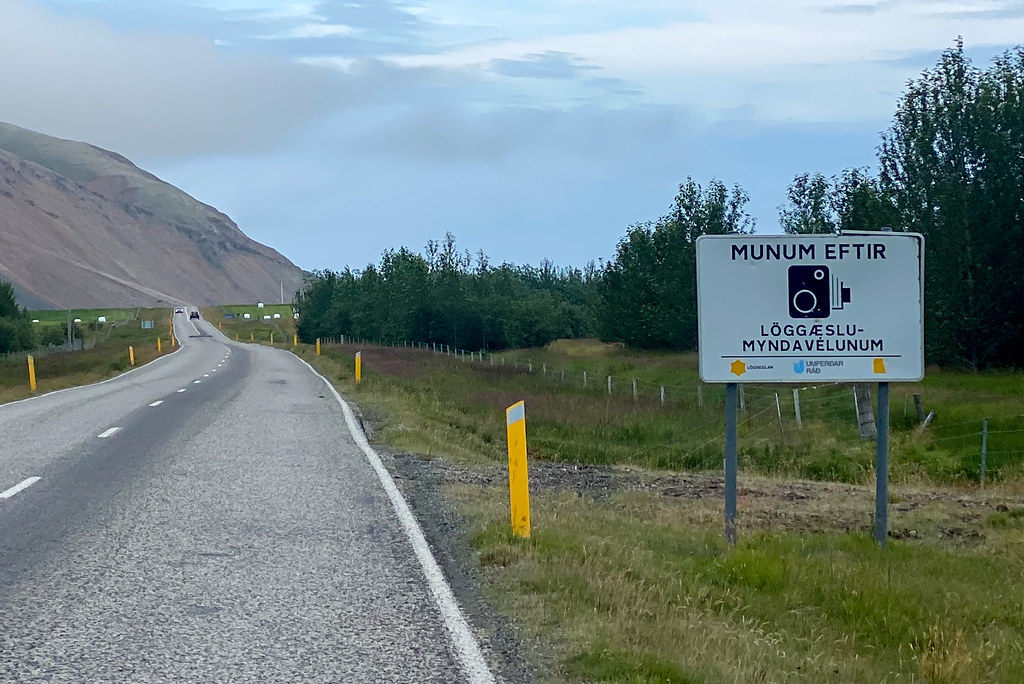
I’m pretty sure this sign is announcing police cameras.
A cement house seems like a great idea right up until a massive crack appears in one wall and you start wondering if you’ll wake up one morning under a pile of rubble…
A cement house seems like a great idea right up until a massive crack appears in one wall and you start wondering if you’ll wake up one morning under a pile of rubble…
The road went on. I passed over a rough bridge spanning Hornafjörður and turned southeast, into the wind. The road got a bit lumpy, making a late effort to sabotage my tire.
Just as my Warlock Holmes book ended, I rolled into Höfn. At the far end of town I located my rental, booked on short notice the previous day when it looked like I might actually get here.
Mom
Yes! You made it!
Me
Yup! Sore legs though!
Mom
What is your hotel like?
Me
It’s an AirBnB. The room is small but comfortable enough. Just set up the laptop!
Mom
A few days of enforced rest will be good for the old leggers. Decent food nearby?
Me
Just ate fish and chips, and a burger with an egg on it!
Mom
That should do it!
I was hoping to spend the additional waiting days in the local campground to save money, but I’d been unable to book there in advance. The idea of just plopping down my tent so late in the day, only to be shouted awake in the morning, did not appeal to me. I’ve learned that campgrounds in densely populated areas are run a bit more strictly than the ones in the hinterlands, even in Iceland.
That was a problem for “tomorrow me”. For tonight, my job was to shower and creep into the bed.