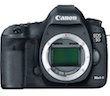
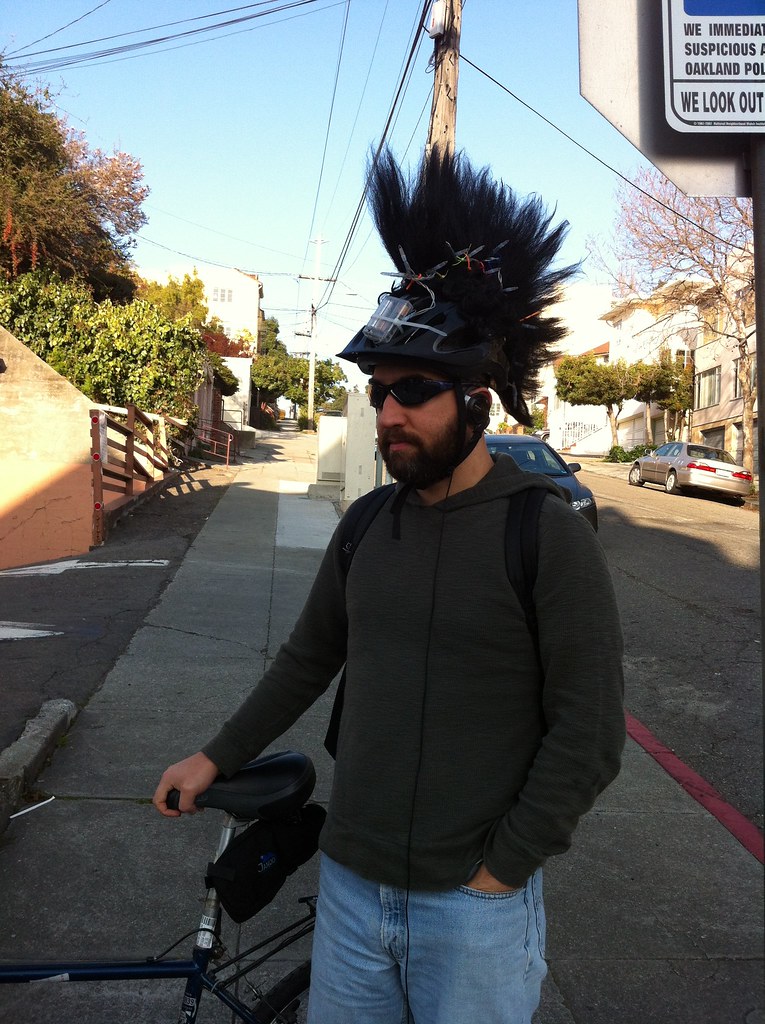
Canon EOS 5D Mark III 22.3MP SLR Camera

So far this is the most expensive piece of gear I’ve ever purchased. You can bet I agonized for quite a while knowing that by getting it I was extending my mortgage for six months. But how often do you get the chance – and the time – to tour New Zealand?

My Canon 50D was starting to show a lot more grain in photos than I remembered seeing when I bought it. I don’t understand why; maybe some kind of sensor degradation after thousands of photos. Or maybe I was just expecting more from the camera. When I got the 5D I swapped my old lens onto it and took a walk around town shooting photos at night, and the grain was completely gone. In fact, the difference was as big as the difference between my old camera and my cellphone. This thing absolutely devours light.

After thousands of photos in New Zealand and elsewhere, I have only one small regret: It’s still a chore to add GPS data to photos from this thing. It still requires an extra step, instead of happening automatically and with no secondary device. That aside, I would confidently take this thing around the world, knowing that with the right accessories I could get exactly the shot I wanted, any time, any place.

Cardo BK-1 DUO Bluetooth Cycling Headsets

Kerry and I used these almost every day during our month in New Zealand, even in pouring rain, and they fundamentally changed our riding experience.

Wearing them, we just speak like we’re right next to each other all the time. We never have to raise our voices over road noise. The software inside the headsets automatically turns up the volume of the speaker, and turns up the threshold of the microphone, when ambient noise increases. When you draw up close to another rider, the units actually detect their own echo and shut off temporarily. This will keep you from going insane. The software driving them is obviously very smart.

Before, it was impossible to communicate if one of us was going faster than 15mph, or got more than 25 feet away. Now, it’s effortless, and the experience of biking together is much more intimate. They also enhance our safety a great deal, because we no longer have to crane our necks to hear each other when riding single file, or when it’s windy, or when there’s traffic noise. We can say things like “pothole ahead” or “turn left” or “watch out for the next curve” even at 20mph on a downhill. When we’re farther apart we can actually hear an approaching car in the other rider’s headset, so if we’re on a quiet road we have longer to prepare for the car, and the person in front can even tell how far behind the other rider is by listening to the delay.

In addition to using them as full-duplex intercoms, you can use them as bluetooth headsets for your phone, and they work just as well in that mode. They will also play music, via bluetooth or a line-in jack, and switch between audio sources automatically when prudent. The music part is a disappointment though. The speakers don’t have very good bass reproduction, and the switch between music and voice has a long delay. It would be much better if they just reduced the volume of the music around the voice – what audio engineers call “ducking” – but they don’t do that, even with the line-in.

Every now and then they will forget their pairing when they’re first started up, which delays things by about 15 seconds in the morning. But then they will last for an eight-hour ride, so there’s no need to shut them off until you’re done for the day. Recharging them will take hours, though, so you better have a free USB port for each unit, and you’ll want to charge them every day – because you will miss them sorely once you get used to them. The unit can unclip from the helmet, so you don’t have to stick your helmet next to your USB hub while you’re charging it.

If you’re traveling on a bike with a partner, or in a group, get a set of these as soon as possible. They are worth the price.

(In 2016 Cardo’s cycling products were acquired by Terrano, so look there now.)

That’s Great, But, What Have You Been Up To LATELY?

Biking around Oakland all day like some punk-ass deadbeat hipster has been lots of fun.

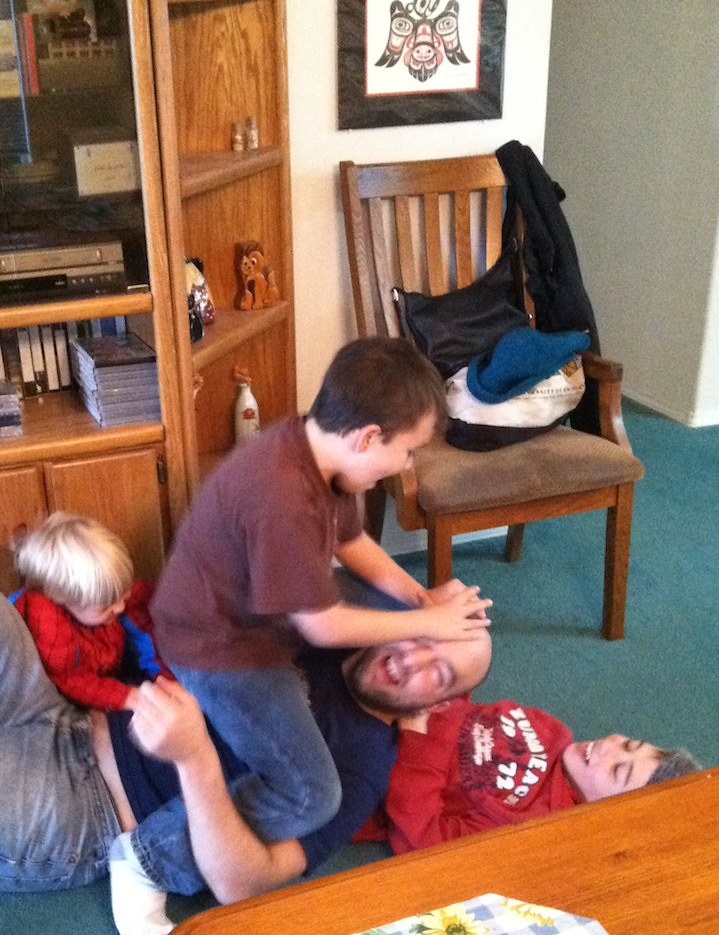
Also, visiting my parents and sisters and nephews during my time off has been totally awesome.

Don’t worry, there was no permanent scarring. Heh heh heh.

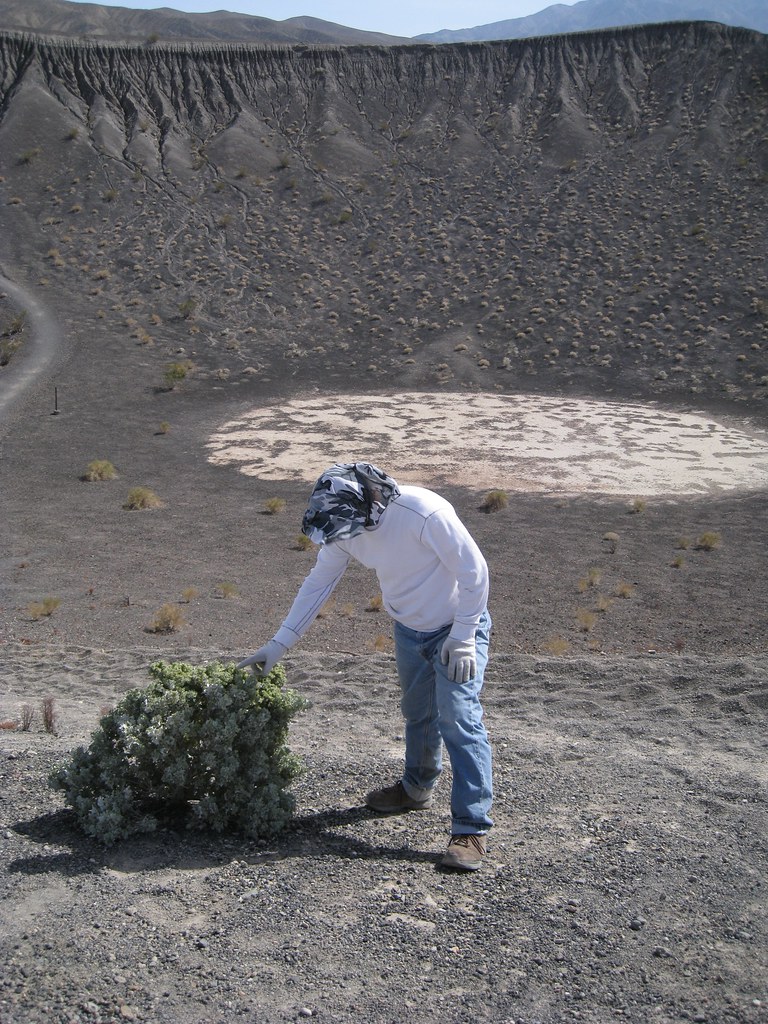
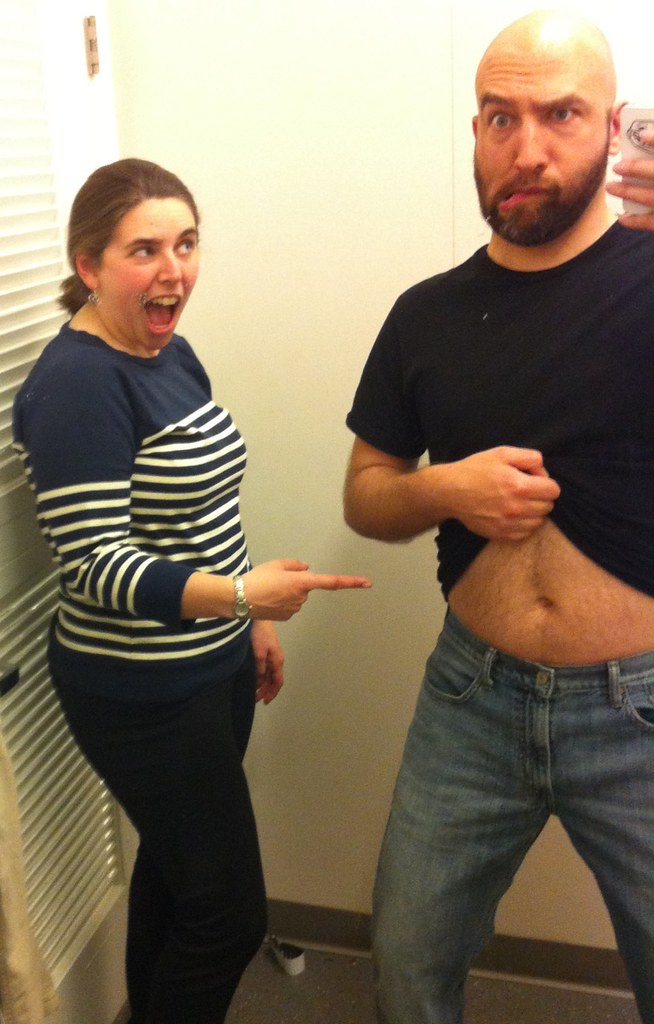
Not to mention the vacations with Erika. She took a picture of me finding … (band hit) … A SHRUBBERY !!!

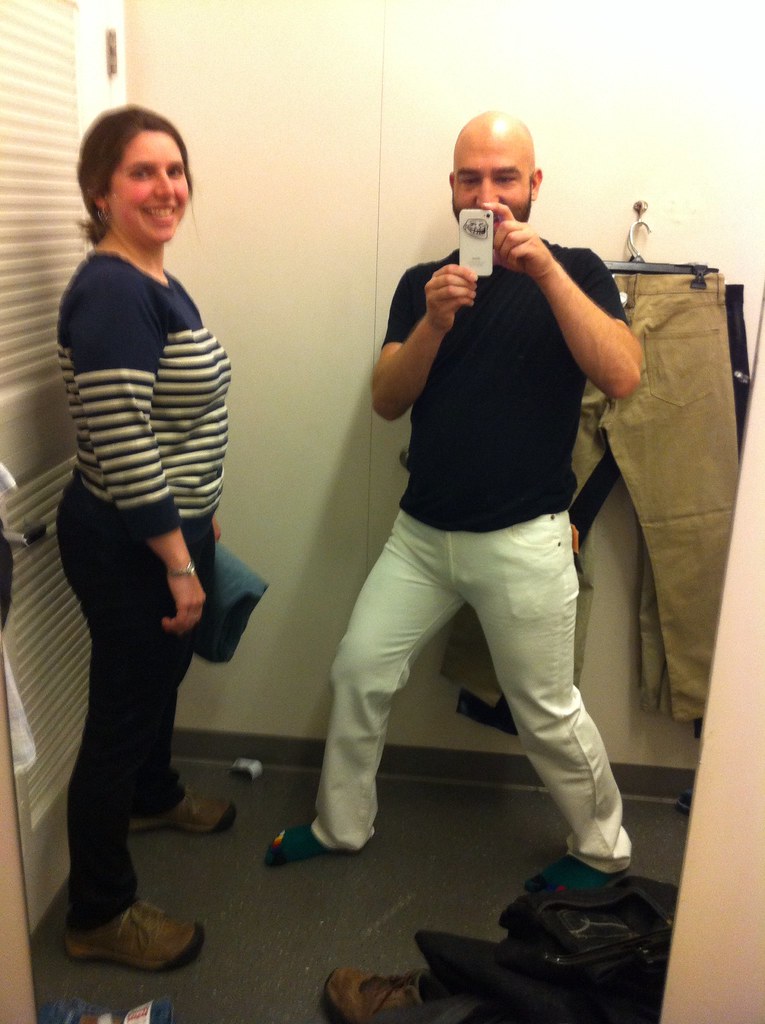
Our adventures also reached the dizzying heights of … (wait for iiiiit) … SHOPPING FOR PANTS !!!

Should Garrett buy these? Y/N?

In total, I can surely say it was an Excellent Adventure and a Bogus Journey.

But lesson learned: I need to work on big things I believe in, or I feel rudderless. That is why, after a few rounds of interviews, I began working at the Joint Bio-Energy Institute in Emeryville. Contrary to what the name implies, they do not spend all day rolling joints and flailing about spastically. It’s all about alternative fuel research and genetics, yo.

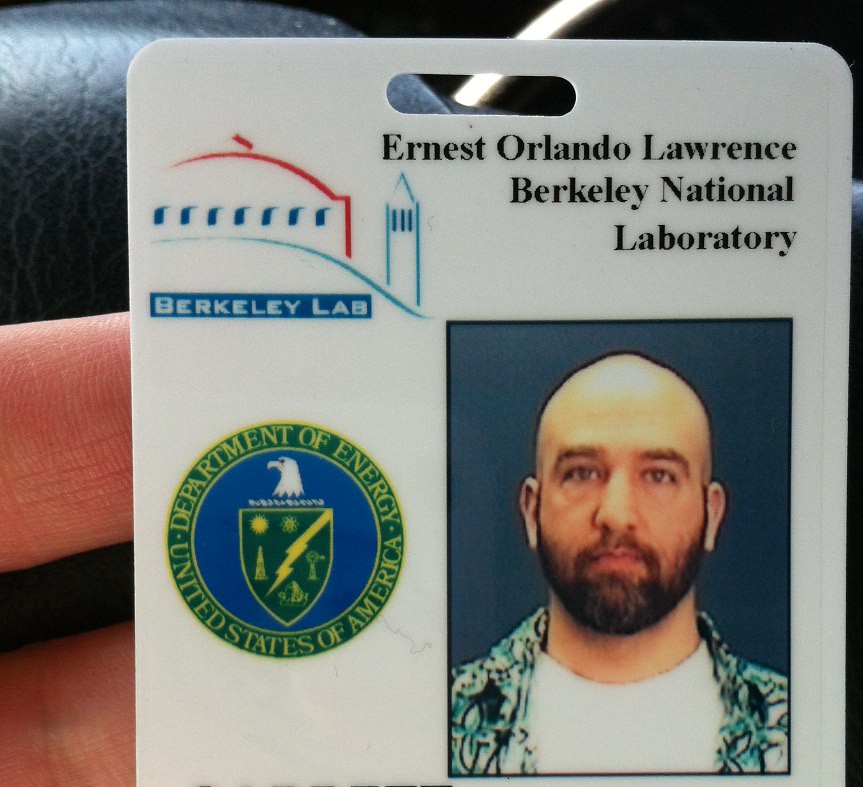
The JBEI is a 20 minute bike ride from my house. Flippin’ sweet. Yesterday I picked up my badge:

I also got a tour of the place. You know those tacky commercials where some actress puts on a white lab coat and stands in front of some complicated beeping machines and glassware to convince you that Bob’s Double-Nose Enhancement Pills are the one true path to enlightenment and skipping merrily through fields of pollen, and also they are definitely not rat poison? The grain of truth in the stereotype is that the white lab coat and the hardware convey REAL SCIENCE, right?

Well, I am now apparently surrounded by REAL SCIENCE.

There are huge rooms here at the JBEI where people in white lab coats stroll around in front of complicated beeping machines and glassware. Tons and tons of glassware; acres of it, with strange liquids writhing inside. There are other rooms filled with thunderous air-conditioning and rows of industrial freezers, with digital readouts saying things like “-80 C”, and signs tacked on the wall reading RADIATION HAZARD and MUST USE PROTECTIVE EYEWEAR.

While I was getting the unofficial walkabout tour from one of my co-managers, I heard a polite voice behind me calling, “Excuse me! Please; excuse me!” I turned around to see a short woman in a lab coat and glasses, with a huge embarrassed grin on her face, and an enormous glass bottle cradled in her arms with some mysterious clear liquid tumbling about inside. She said:

“Can you open this? Like, just loosen it, but not take the lid off? Please?”

Then she handed the bottle. It took a few seconds of careful macho twisting, but I got the cap to turn, and handed the bottle back to her. “You got it! Thank you!” she said, grinning some more, and then turned around and strode back into the lab.

A charming omen for a first day. Like my first day at Apple, when I encountered Steve Jobs in the cafeteria. This omen illustrates the general tone for this new chapter in my working life: I like helping scientists!

The rest of the day was spent setting up my build environment, then diving straight into a thorny mess of code. Afterwards I was dead tired, but Erika gave me a ride to the Soup Restaurant of Deliciousness, and I perked up over the meal. We had an excellent time.

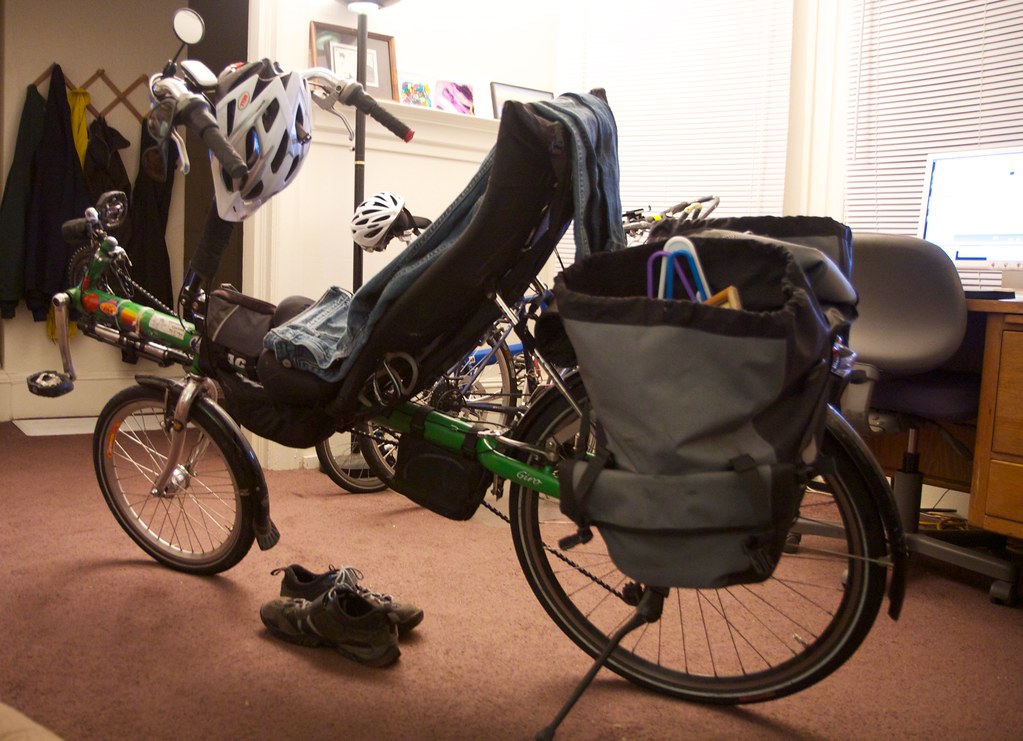
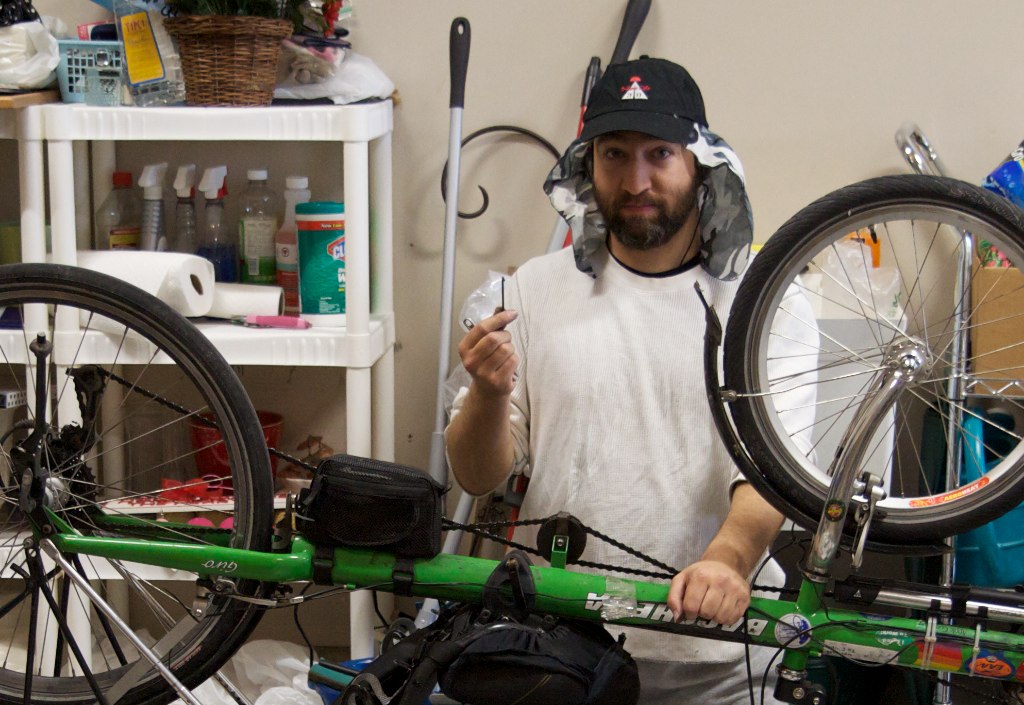
That night I prepped the recumbent in the living room:

Inflated tires, oiled chain, tightened bolts, and reattached storage bags.

The bags contained items to customize my work area:

  • Six dark chocolate peanut butter cups.
  • A box of dark-chocolate covered walnuts.
  • Three Hawaiian shirts with matching plastic hangars.
  • A framed painting of a striped kittycat that has been on all of my office desks since 1998.
  • A pair of shoes
  • A hefty bike lock
  • My newly minted badge
  • A toothbrush

Some time after I packed it up and rolled sleepily into bed, Erika sent me an Emoji version of how my next day would go:

She got it spot on. The ride next morning went perfectly, and the recumbent sparked a conversation in the parking garage, and I made a new friend, then another in the elevator on the way up to the fourth floor.

The second day: Eight hours of A-game hacking. By the end of the session, I’d learned a ton of new things about Java, Tomcat, Ant, and Indigo, and I’d come up with a good strategy for untangling the design flaws in the my newly-assigned project.

Awwww yeah.

Then I rode home, fed the cat, grabbed some laundry, rode to Erika’s, and we dashed out to catch yoga. An hour-and-a-half of balancing, stretching, and serene, focused movement. An excellent Tuesday ritual. Between this and the bombastic expression of Karaoke I think I have a good thing going.

Let’s see where it takes me!

Packing Up The Bike

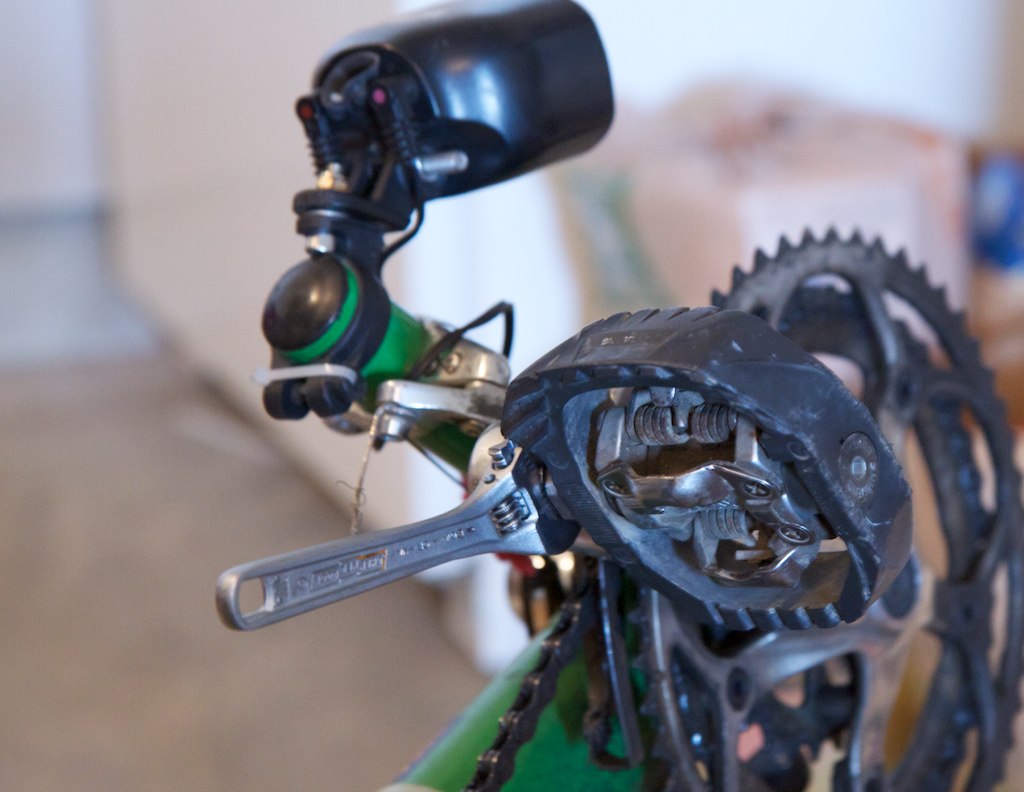
The key to taking apart a bicycle is to have one of these on hand. It’s a tiny adjustable wrench, small enough to carry in a toolkit and lock nuts in place, and just big enough to remove the pedals from a bicycle.

And, of course, you need a variety of hex wrenches!

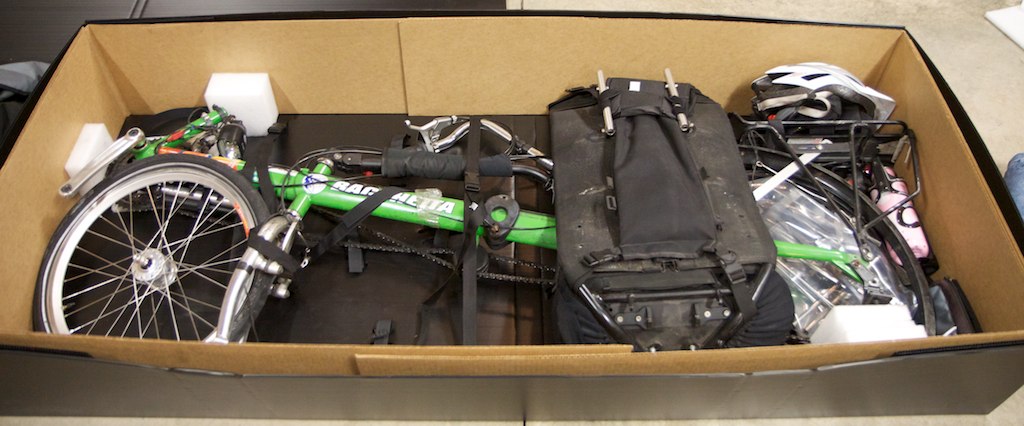
The key to transporting a bicycle once it’s in pieces is to use a sturdy box. After sinking a big chunk of money into the recumbent itself, I figured I could justify spending a chunk to get it home safely. I chose the Crateworks “tandem”-size box.

It’s freaking enormous. 70 x 11 x 32 inches. Even so, it was just long enough for me to fit the main boom of the recumbent in diagonally. Around that I packed almost all of my gear – three of the bike bags, the clothing, the sleeping bag, the tools, the spare tire, and some remaining food. The fourth bike bag remained outside, so I could use it as carry-on baggage for the plane ride home.

Recumbent disassembled and placed into a Crateworks long-style box.

It took most of a day to break down the bike and install it in the box. The end result was close to 110 pounds, the ceiling for cross-country oversize shipping at the local FedEx depot.

The box is clearly labeled with arrows indicating “this side up”, but as far as I can tell, FedEx employees totally ignore these. When it arrived in Oakland six days later it was upside-down in the back of the truck, and the delivery agent dragged it out and lowered it by turning it end-over-end, leaving it upside-down on the sidewalk in front of me. At least he helped me carry it into the house.

Interestingly enough, due to the seasonal discount on my plane ticket, it cost just as much to ship a 110-pound box home in a week as it cost to fly my 180-pound ass home in 12 hours.

After the Trinidad to Toledo ride: What would I keep; what would I change?

First things first: The recumbent was awesome!

I would not use any other style of bike for such a long trip. I never had to worry about saddle sores, or aching wrists, or a kink in my neck. My wind profile was nice and low, and my luggage capacity was high.

My decision to leave behind my tent was a good one, since there were almost no places to camp along the way. I suppose I could have asked strangers if I could camp in their yard or on their farmland, but as a lone traveler on a long haul with some expensive gear, I didn’t feel comfortable enough. With two people sharing a tent the variables are different, I’m sure.

Other changes I would make: New gloves. My ski gloves didn’t block moisture, and that was a problem. I also needed some kind of waterproof over-sock, so I didn’t have to use plastic shopping bags. I used the bags even when it was dry out, to reduce windchill. I know there are waterproof covers for biking shoes, but I don’t like them for three reasons: First, they’d get beat up whenever I walk around off the bike. Second, they all have a hole in the bottom to expose the pedal clip, and on this recumbent, the soles of my feet go vertical during each pedal stroke. After half an hour of cycling into a rainstorm, the liners would fill with water. And third, I can’t find any in my size. Bah! So that’s still an unsolved problem.

My water sack had a slow leak, so I couldn’t use it for this trip. I kept all my water in metal canteens instead. They didn’t seem to add much weight, and they could attach to the outsides of the bike. I never worried about dropping or puncturing them.

Toolkit:

The toolkit was great. I used the needle-nose pliers to remove thorns from my tires, pull my brake cables, cut zipties, loosen the valves on my tubes, and manipulate the wiring on my hub generator. I used the miniature wrench to adjust my headlamp, and attach and remove my rack, seat, tail light, and pedals. It would have been almost impossible to disassemble the bike without those.

The plastic tire levers saved me a lot of trouble. I used a bunch of the zipties, and almost all of the chain oil. I used the hex keys, of course. I had a swiss army knife, and I used the knife, bottle opener, screwdriver, scissors, and saw (to cut a hat brim to extend my helmet). I used the tire pump a dozen times – totally worth it. (A spare tire is useless if you can’t get it inflated, right?) My set of folding scissors turned out to be completely frivolous. Those are out. I didn’t use the electrical tape, but I’m strangely reluctant to discard it. To my relief I didn’t need any of the spare parts (screws, washers, chain link, brake pads), or the tire repair kit, or my medical kit – but I’m keeping all those. I should probably add a chain tool, and a spare 20-inch tire to go with the tube.

Tech toys:

The laptop was very helpful in the evenings. It was powerful enough to deal with my photos, and the physical keyboard was great for my logs and correspondence. I researched my route on it from hotel rooms, with maps and weather reports and topography and restaurant menus all open in the web browser. The extra USB ports charged my gadgets at night. Doing all this stuff with a tablet – the iPad even – would have been much harder. It doesn’t have the horsepower, and even with a detachable keyboard, there is basically no concept of “keyboard navigation”, which would drive me bananas.

In fact, I should have left the iPad at home. The only time it was uniquely useful on the trip was when I wanted to look at a map, and AT&T didn’t get a signal to my phone, but Verizon got a signal to the iPad. That’s it. Sure it made a good conversation piece and it was fun to watch The Daily Show on it in restaurants, but that didn’t make it worth the weight. Next time it’s staying home.

I brought that Contour GPS camera along for the entire ride, but never turned it on once. It was just too easy to use the iPhone for taking video, and I knew that if I dug out the Contour I would have to wait at least 30 seconds for it to get a GPS lock. Then there would be the effort of importing, cropping, and transcoding the video… Next time I’ll just leave that thing at home.

All my gadgets stayed dry, thanks to those waterproof “lok-saks”, and an overabundance of sandwich bags. I could have used another dry-sack for dirty laundry, instead of just cramming it straight into the pannier.