Canon EOS 5D Mark III 22.3MP SLR Camera

So far this is the most expensive piece of gear I’ve ever purchased. You can bet I agonized for quite a while knowing that by getting it I was extending my mortgage for six months. But how often do you get the chance – and the time – to tour New Zealand?

My Canon 50D was starting to show a lot more grain in photos than I remembered seeing when I bought it. I don’t understand why; maybe some kind of sensor degradation after thousands of photos. Or maybe I was just expecting more from the camera. When I got the 5D I swapped my old lens onto it and took a walk around town shooting photos at night, and the grain was completely gone. In fact, the difference was as big as the difference between my old camera and my cellphone. This thing absolutely devours light.

After thousands of photos in New Zealand and elsewhere, I have only one small regret: It’s still a chore to add GPS data to photos from this thing. It still requires an extra step, instead of happening automatically and with no secondary device. That aside, I would confidently take this thing around the world, knowing that with the right accessories I could get exactly the shot I wanted, any time, any place.

Cardo BK-1 DUO Bluetooth Cycling Headsets

Kerry and I used these almost every day during our month in New Zealand, even in pouring rain, and they fundamentally changed our riding experience.

Wearing them, we just speak like we’re right next to each other all the time. We never have to raise our voices over road noise. The software inside the headsets automatically turns up the volume of the speaker, and turns up the threshold of the microphone, when ambient noise increases. When you draw up close to another rider, the units actually detect their own echo and shut off temporarily. This will keep you from going insane. The software driving them is obviously very smart.

Before, it was impossible to communicate if one of us was going faster than 15mph, or got more than 25 feet away. Now, it’s effortless, and the experience of biking together is much more intimate. They also enhance our safety a great deal, because we no longer have to crane our necks to hear each other when riding single file, or when it’s windy, or when there’s traffic noise. We can say things like “pothole ahead” or “turn left” or “watch out for the next curve” even at 20mph on a downhill. When we’re farther apart we can actually hear an approaching car in the other rider’s headset, so if we’re on a quiet road we have longer to prepare for the car, and the person in front can even tell how far behind the other rider is by listening to the delay.

In addition to using them as full-duplex intercoms, you can use them as bluetooth headsets for your phone, and they work just as well in that mode. They will also play music, via bluetooth or a line-in jack, and switch between audio sources automatically when prudent. The music part is a disappointment though. The speakers don’t have very good bass reproduction, and the switch between music and voice has a long delay. It would be much better if they just reduced the volume of the music around the voice – what audio engineers call “ducking” – but they don’t do that, even with the line-in.

Every now and then they will forget their pairing when they’re first started up, which delays things by about 15 seconds in the morning. But then they will last for an eight-hour ride, so there’s no need to shut them off until you’re done for the day. Recharging them will take hours, though, so you better have a free USB port for each unit, and you’ll want to charge them every day – because you will miss them sorely once you get used to them. The unit can unclip from the helmet, so you don’t have to stick your helmet next to your USB hub while you’re charging it.

If you’re traveling on a bike with a partner, or in a group, get a set of these as soon as possible. They are worth the price.

(In 2016 Cardo’s cycling products were acquired by Terrano, so look there now.)

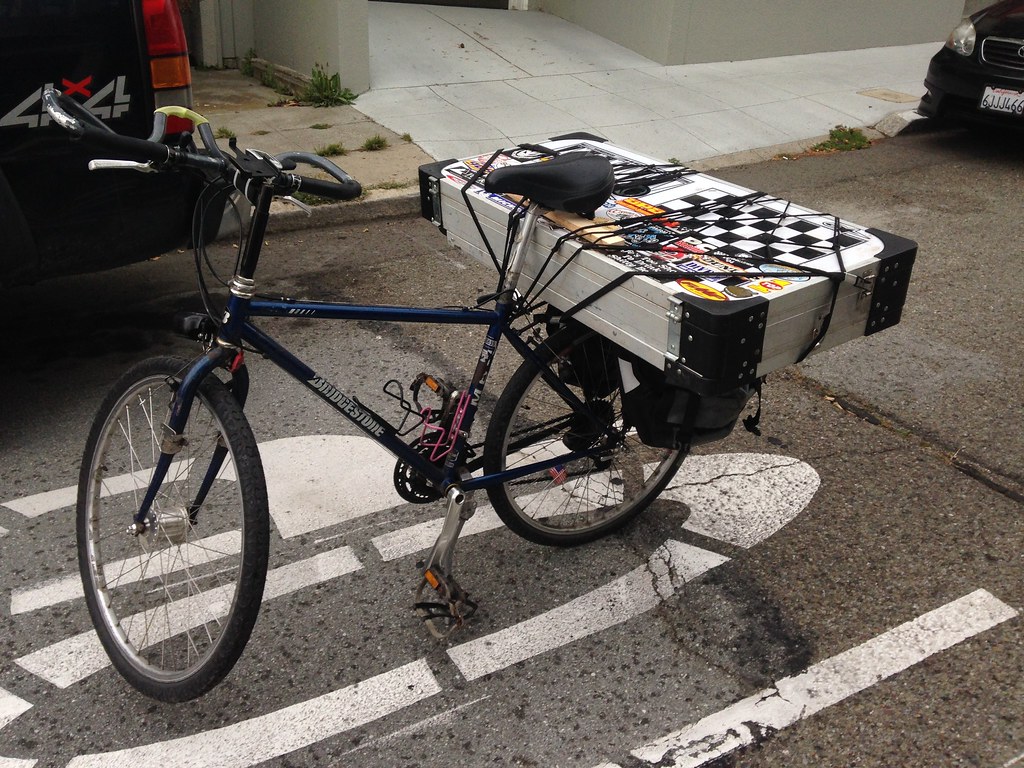
The lengths a person will go to, to avoid driving in San Francisco…

The stickers make it look cooler than it is. It’s actually an aluminum table that folds up nicely for camping.

Found it on Craigslist. It would have taken me just as long to find rush-hour parking for my van, I swear!

Plastic

My city has a separate recycling mechanism for plastic bags, relative to the standard throw-it-in-the-can method we used for everything that has a little symbol on it.

There are free dropoff points for plastic bags around the city, and if you feel like a good samaritan, you can haul your bags out there and stuff them in.

This is approximately eight months’ worth of plastic bags for three people.

Some of it was wrapped around vegetables from the supermarket. Some of it was peeled off the lids of yogurt and soup and sour cream containers. Some was used to transport cables, or batteries, or zipties, or bread, or bars of soap. There are bags in here from restaurants, hardware stores, pharmacies, gas stations. A surprising amount of it was packing material that arrived in the mail.

One night I stuffed it all into my bike trailer and pedaled it out to the recycling kiosk outside the Safeway.

I don’t know where it goes from there, but I hope at least that it stays out of the ocean.

The big bucket back at the house remained empty for about two days. Then I received a piece of junk mail – a catalog – wrapped in plastic. The plastic went into the bucket.

How to go on a bike trip: The very short version

Get a bike. Ride it around the block. If anything hurts, take it to a local bike nerd and ask them to make it stop hurting.

Ride a mile away, then a mile back. If anything hurts, repeat the above step. Keep repeating it until nothing hurts. (Sore is okay. Hurts is bad.)

Go to the bike touring section of Wikiloc and pick a route that’s close to your home. There’s a smartphone app you can use to follow the route, and if you’ve got a GPS, you can load the route onto it.

Don’t let your physical shape hold you back. You will get in shape as you go! Stay within these guidelines when you’re starting out, and you’ll be fine:

  • An elevation change of 1000 feet in less than three miles is the border between ridable and not ridable.
  • Budget for about 30 miles a day. So, if you end up riding 45 miles for two days, your budget will let you hang around town and be a tourist on the third day. (Ignore all those people who talk about 50, 70, 100 mile days. The key word here is “budget”!)
  • On flat ground, count on about nine miles per hour. (This factors in all kinds of possible degradations – wind, potholes, rest breaks, photo stops.)
  • If you’re riding “fully loaded”, i.e. with camping supplies, and there’s two of you, budget for about 50 bucks a day per person. (That figure is for journeys in the western states of the US though, and will be different elsewhere.) With that budget you can afford to feed yourselves well, stay in the occasional hotel, and indulge in some touristy things, like museum tours and ferry rides.

Take a picture of something along the way, and post it online, with the comment, “SAW THIS ON MY BIKE RIDE!” That will get the conversation going.

Congratulations!