It is what it is
February 18, 2019 Filed under Uncategorized

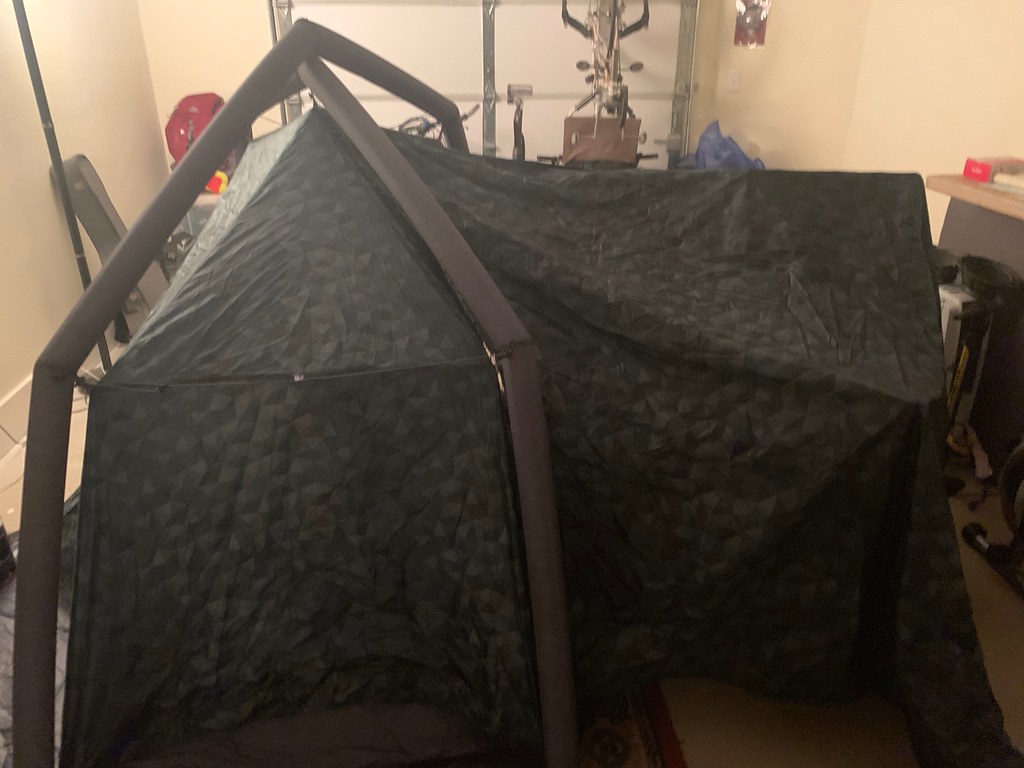
Note that in all the photos below, I have attached a large Heimplanet tarp to the side of the Fistral, creating a enormous vestibule. (See postscript at the bottom of this post.)

Another site, another setup.

Tent all spread out, ready to inflate.

Tent inflated, with bicycle stowed under, from a different angle.

Doing laundry in the midday sun.

Drying out items before packing.

Comfy as usual!

Tent inflated, with bicycle stowed under attached tarp. That red mark is the taillight, visible through the fabric.

Snug as a bug.

You can see my hack job here, where I ziptied a tarp to the side of the tent. From a distance it almost looks like it was designed this way…

The tent, tucked into a nice corner of the Búðardalur campground.

Had to use one guyline here, on account of the high wind. Still a pretty good site!

Another fine camping spot.

All set up for a long stay.

Set up in the corner of the campground, for maximum wind blockage.
The Fistral is my favorite one-person bike touring tent. It’s roomy, versatile, and absurdly easy to set up over and over again, even in the dark. The extra weight is worth it. I’ve taken it all over, from the Nevada desert to the rainy shores of Iceland.

Reading the morning memes.

Setting up the tent for the last time, and trying not to get bitten in the process…


Aside from the difficulty in high wind (30+ mph), this is a really great all-around tent. I’d say it’s the best one Heimplanet makes, drawing on everything they’ve learned from previous designs.


This tent is too heavy for backpacking or biking, but I’ve deployed it on many vehicle-based camping trips, including the California mountains and at Toorcamp in Washington. It’s sturdy, dead simple to deploy, and easy to clean, though the narrow door doesn’t do it any favors. It’s the first and the most eye-catching design by Heimplanet, and it got me hooked on the whole idea of inflatable tents.


Huzzah, the tent is repaired!

It was a small campsite but the parking space was big.


For one person this is overkill, and for two it’s luxury. You can stick the equivalent of a queen size bed in here and still have room for your stuff. Far too heavy for bike touring, but it’s been part of my standard car camping gear ever since it was introduced.

This is the only tent Heimplanet makes that absolutely requires stakes. Without them, the sleeping areas will not take their shape.
Based on the above, it seems to make the most sense to travel with the Fistral through remote areas, use the Kirra for more rural camping, and use the Backdoor only when traveling with three or more companions.
This is a little disappointing, since the Backdoor is luxurious to use. Lots of ventilation, tons of space, room to work inside, a giant vestibule for cooking… It’s too bad it weighs so much, because if I’m going to be living in a tent for months at a time, I’m going to need a place that can feel like a home.
Since my first few rounds of using the Fistral I’ve discovered that it’s possible to clip a lightweight tarp to one side of it and use the tarp to cover a bicycle parked parallel to the tent, with most of my gear still on it.
With the tarp attached, the Fistral is basically a good-sized one-man tent with a rear vestibule that’s larger than the living space. When the edges are staked down on opposite ends of the bike, the entire bike forms the outside wall of the vestibule, keeping the contents – bike included – safe from rain, and easily accessible through one of the doors in the tent. It’s also ventilated enough for cooking.
With the bicycle visibly concealed and staked down it is far less likely to be snatched by thieves, and I never have to worry about a wet seat or chain when I pack up in the morning.
I’ve deployed this tent dozens of times over multiple trips and years, and it’s worked brilliantly.


January 30, 2019 Filed under Curious, Introspection
It’s already obvious that I am pretty obsessed with bicycle touring. As time and funds have permitted in my life, I’ve taken longer and more complicated trips, the longest being about two months. Occasionally I hear about other bike tourists who are so hardcore and obsessed that they have cycled across entire continents or even around the world. That idea has always felt bold and intimidating, but not for me. The last time it came up was seven years ago, and it dropped into the back of my head and percolated there until I forgot about it.
Fast-forward a bunch of time, to 2018. Last year, I was feeling stagnated in my job, tired of my living space, and bored with the geography of the Bay Area. I’d been obsessively playing the computer game Civilization V, and the art deco monuments and colorful pastel mountains and rivers had colonized my imagination. The world was full of light and conflict. I’d just finished a loopy sci-fi novel by Stephen Baxter about spacefaring Roman legions and moon-dwelling Incan tribes, and though the premise was absurd, the collision of remote culture and high technology was inspiring. It came up again in a surreal novel by Dan Simmons: Quantum technology and the siege of Troy, on Mars! My mind was an avalanche of sandstone and granite ruins knotted with ivy and wildflowers, teeming with people in exotic clothes, trading or fighting or building together.

I was seized with the urge to take a vacation, and go far out into the world and touch the artifacts of history. But while I was still working, it would have to be a typical Silicon Valley “get away from the desk” vacation, and I knew how those usually went. I’d be in a rush, moving between various modes of transport, skipping across thousands of miles to hit a packaged highlight reel of well-traveled attractions, trying to use the experience as a hammer to smash some dents into a brain shaped by months and months of software engineering. The vacation would not be for its own sake, it would be to prepare me for another six months back at work.
I knew that would not do. These ideas were calling for a bigger change. I spent several weekends biking around and sketching in the beautiful Mountain View cemetery at the end of Piedmont Avenue, enjoying the fresh air and the quiet, sun-warmed granite monoliths. I began browsing around in Google Earth, tracking down the cities I’d conquered and the wonders I’d built in Civilization, and reading about the history and geography of far off places. Samarkand… In the first edition of Civilization it’s the seat of power of the Mongolians. In Civilization V it’s a powerful, independent city-state usually located in desert. Where is it really? Here it is, in Uzbekistan. There’s a country named Uzbekistan? Wow, I didn’t even know that. How could there be a country that I do not know the name of, at my age?
I started thinking a lot about my picture of the world, and how much of it was based on unverified assumptions, convenient metaphors, current political fashions, and apocryphal stories. I felt intensely ignorant and confined. I needed to break out of my routine, and experience the world outside in a direct and personal way. I needed to crowbar myself out of an existence that was too comfortable. If I didn’t have the means now, when would I ever? Suddenly, the idea of a long-range bike tour popped up from the depths of my mind, threw confetti in my face, and said, “hey idiot, remember me?”

At first I didn’t know what to do. The idea was equal parts enthralling and terrifying, giving me a sense of ambivalence, but it was also sticking hard in my brain like a flyer glued to the windshield of a car. A real long-range bike tour means leaving the Bay Area for a long time. It means spending my savings, and it means I need to rent out my current place to help pay for the house, otherwise my savings would vanish immediately. It means quitting or renegotiating my job. It means being away from my friends and family. Most important of all, it means not having a significant other, because what girlfriend in her right mind would actually be interested in a crazy journey like this?
For a while I hoped the idea would diminish, as it had before, so I wouldn’t have to confront its practical details. But it just set up camp and grew larger and rowdier like a Greek army laying siege to the city of my mind. Eventually, during an intense discussion where I felt encouraged to take risks, I spoke out loud about the idea for the first time. It was like opening the city gates. As I heard myself describe it, trying to convey the intensity of it to another person, the Greek army rushed inside, and suddenly I no longer belonged to myself. I belonged to this journey.
So. I intend to begin a long bicycle trip carrying all my gear, starting in Iceland, with a destination of England. Perhaps by then I will be sick of traveling. Perhaps I will settle in England, or return to California. Or perhaps I will continue on, through Spain and France. Perhaps I will circumnavigate the planet. Who knows?
The tentative departure date is 100 days from now.
This raises a lot of questions, like “Are you crazy?” and, “How long will this take?” and, “Are you aware of these things we have, called cars?”, and of course, “Do you know how dangerous this is?”
I’ll answer that last question up front by saying, yes, this is dangerous. In the coming months I’m not going to talk about the danger much, because it’s not something I want to dwell on, but I should at least say that if I do end up frozen solid in a snowdrift, or dead at the bottom of a ravine with my equipment scattered around me, or – most likely – squashed flat by a truck like Wile E. Coyote in the desert, that this is something I accepted as a possibility when I started. And I chose to do it anyway.
Yes, it’s a fatalistic attitude. But in the time leading up to this journey I have become so obsessed with the idea of attempting it that it has started to feel like an inevitability. Like a part of my identity. If I was any less obsessed maybe I would choose to stay at home. Keep circling in that worn-down trench between house, workplace, and supermarkets; maybe take a series of smaller risks. But I honestly feel like I don’t have that choice any more. The Greek army has plundered the city, and is running it now. If I am fated for the snowdrift, or the ravine, or the logging truck, then so be it!
There’s also the possibility that I will grow to hate this journey after I embark. After three or four months on the bicycle, toiling up hills in the middle of nowhere, I may suddenly snap, dump my equipment in a pawnshop, and buy a ticket back to the states. That is an acceptable outcome. But I’m also pretty stubborn, so — we’ll see!
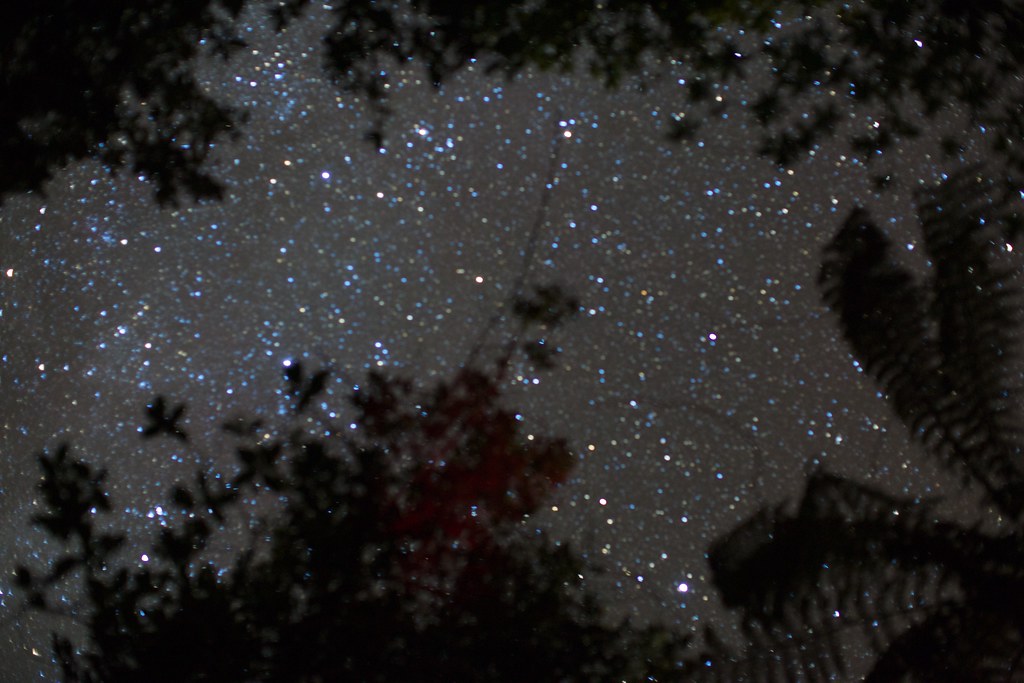
The night sky on the river.
We must, most definitely, see.
October 20, 2018 Filed under Tech
Bacchetta makes – or perhaps only used to make – multiple sizes of handlebars for their recumbent bikes. I ride with the handlebars much closer to my chest than they recommend, and rest my arms across the tops of the bars when I’m going straight — which is most of the time. The only size of handlebars that works for this purpose is the smallest size.
Long ago, Bacchetta used to make their handlebars with a shiny finish, by polishing the aluminum after bending it into shape. Now they use black anodized aluminum instead, with a rough texture. I suppose they switched to black because it looked better with more colors, but a consequence of this change is, the new bars less comfortable on the skin.
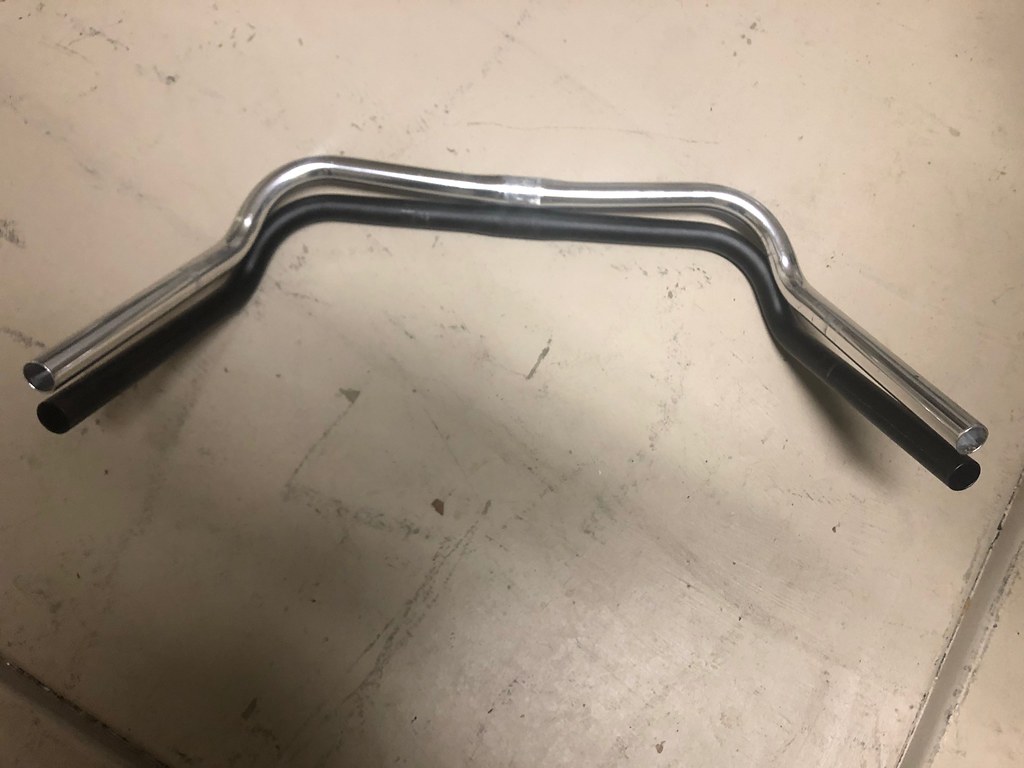
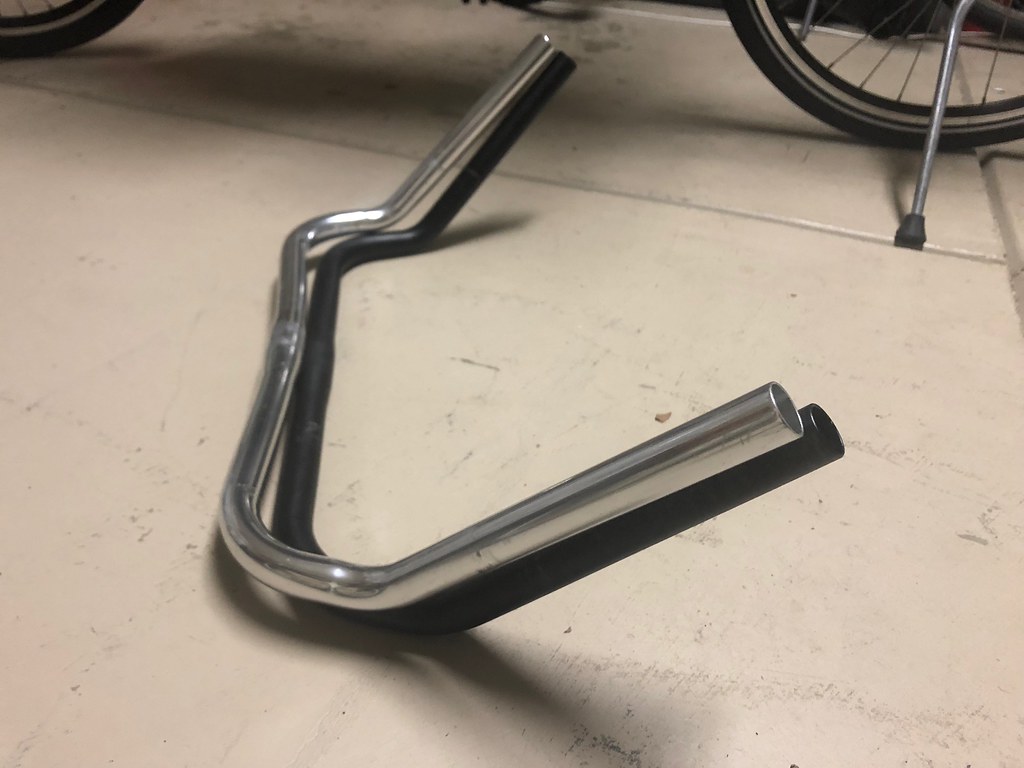
Since I ride with my wrists and hands in contact with the bar itself most of the time, this difference matters to me. So when I built Valoria II, I started with a stock pair of handlebars, then swapped my old ones over when the time came.
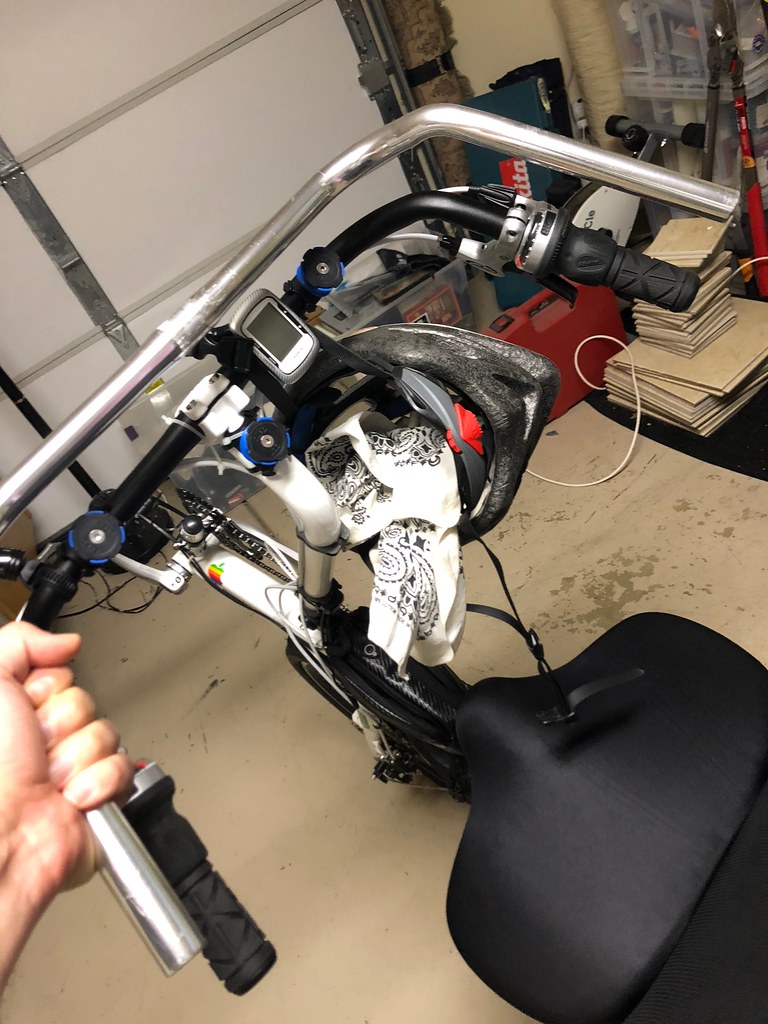
A pair of ancient chrome handlebars on top of a pair of small-size anodized handlebars. They're exactly the same except for the chrome finish.
It was a pretty involved process. I had to remove three mounts, two handlebars and bar-end caps, two brake controls, two shifter controls, the mirror, and the anchor plate. I’m not just riding with handlebars, I’m riding with a whole dang dashboard!
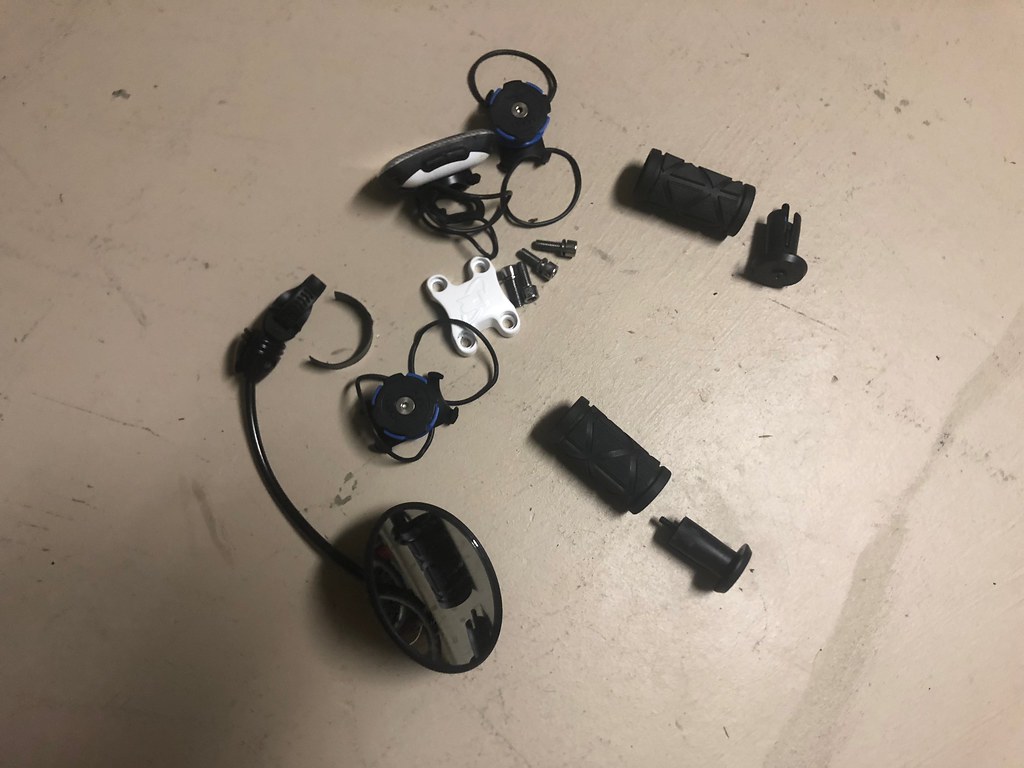
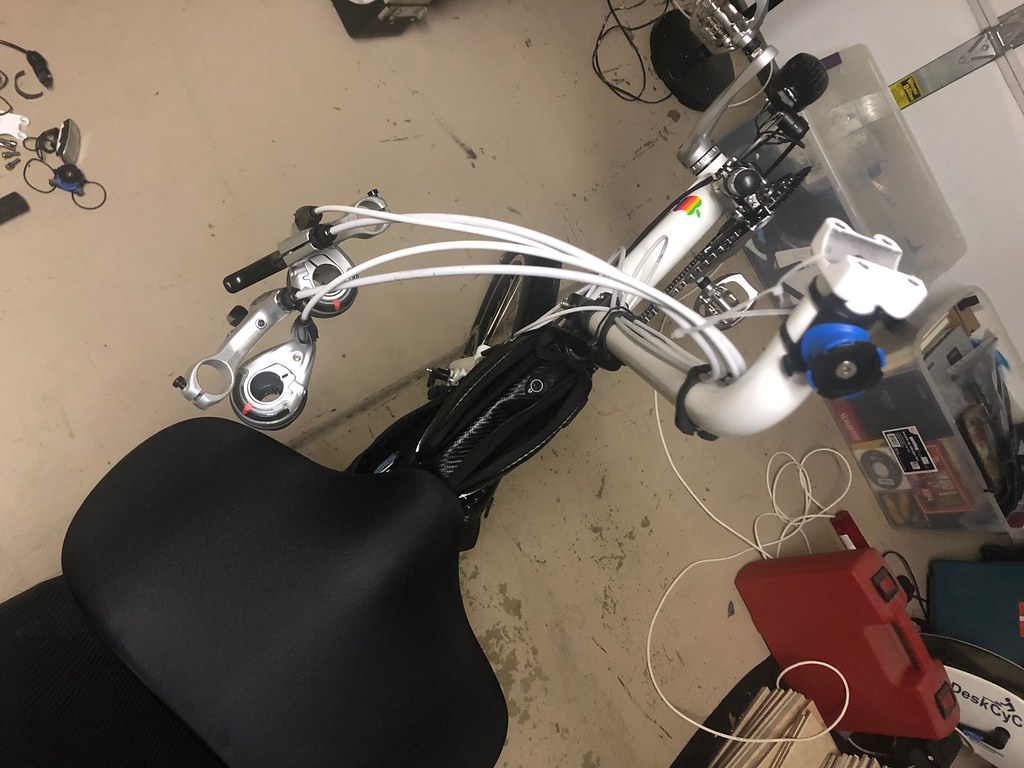
In the end, it was worth it. The chrome feels cool on hot days, and clings to my gloves on cold days.
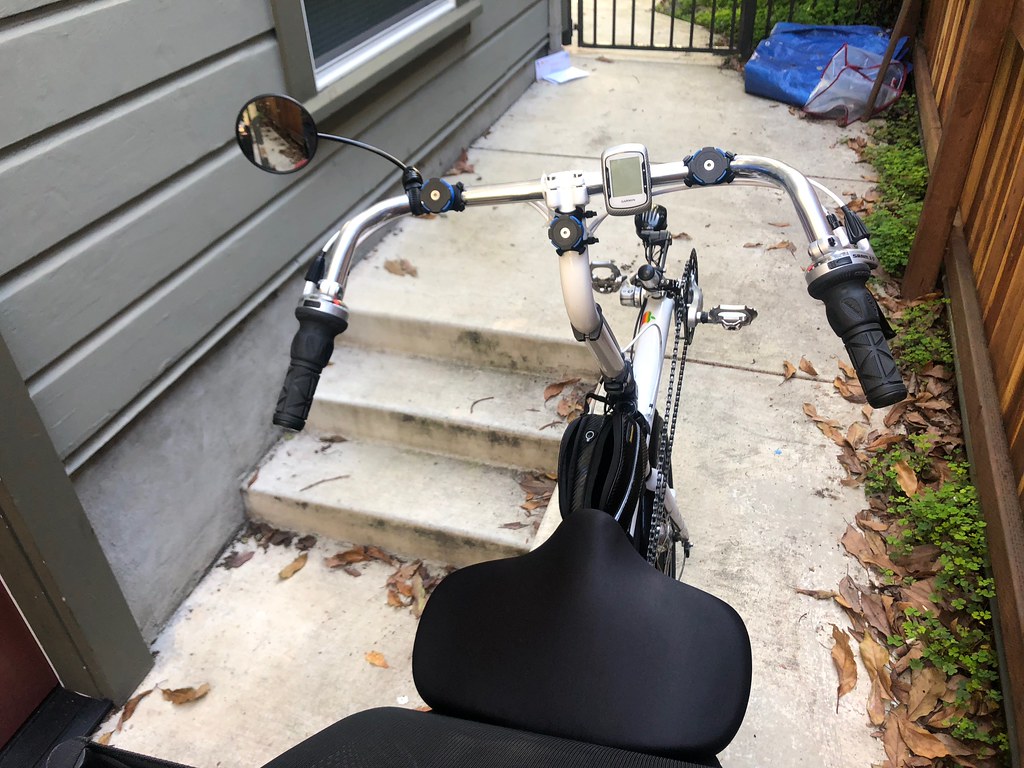
If I lost my bike and had to rebuild it from scratch, I could actually get everything I need brand-new from a variety of suppliers, with the glaring exception of these handlebars. They were only made for the first-run Bacchetta recumbent circa 2001. If I had to find another pair, I’d have to scour the entire country, and most likely I’d have to buy the entire bike just to plunder the handlebars and resell it. Eventually they will all go the way of the old Bacchetta under-seat rack: They’ll all get broken or lost, and then they will be gone forever.
This is one of the many reasons why I lock my bike up with a very serious hardened-steel segmented lock! Arrr!!
It’s hard to find good, versatile hardware, and sometimes the thing I want just doesn’t exist, so I have to get all crafty. This is another of those things I’m documenting for my own reference, in case I need to recreate it.
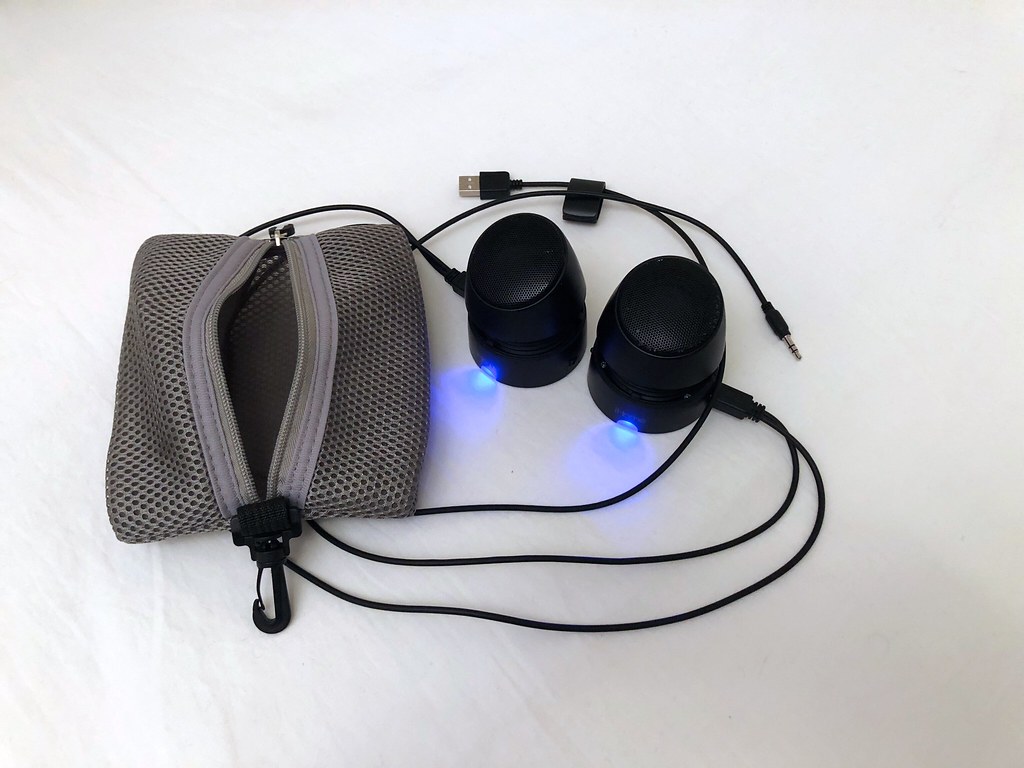
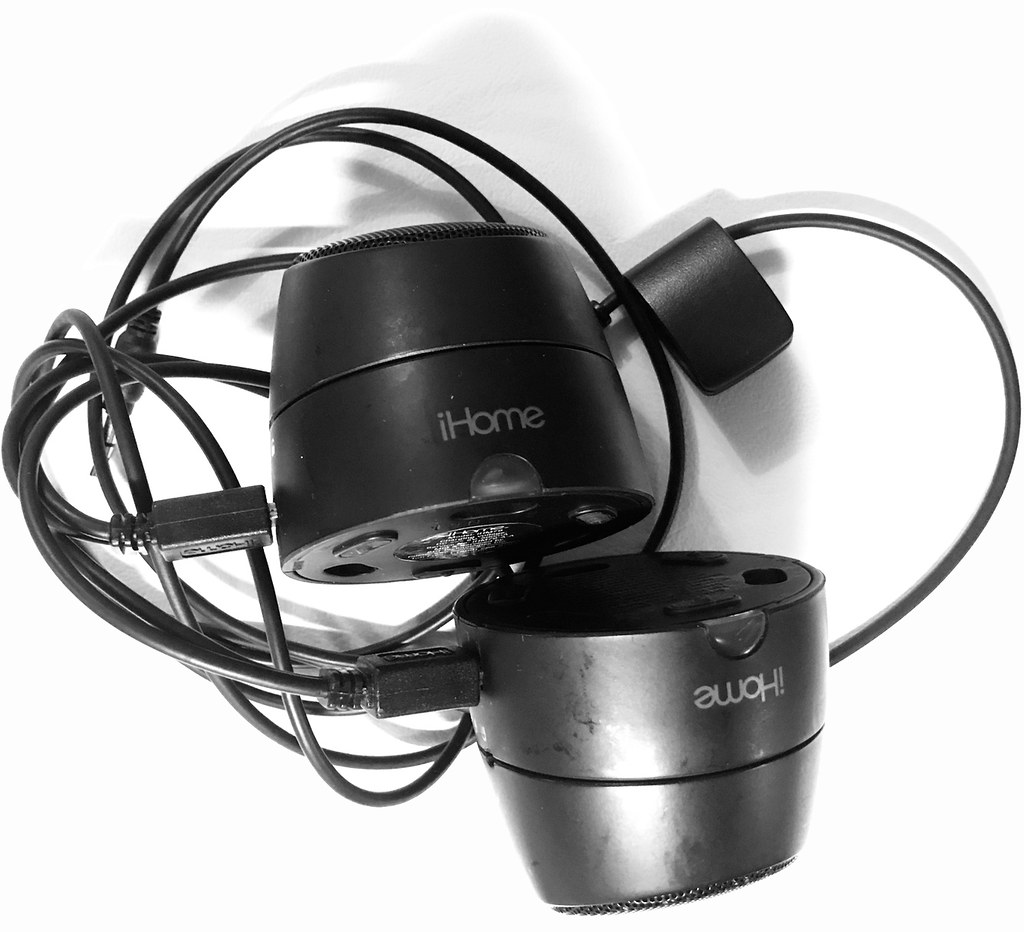
Bluetooth is the new hotness, but wires still sound better - and use less power.
These are the iHome iHM79BC Rechargeable Mini Speakers. They sound good, pack reasonably small and light, and the design is simple. I’ve used them on many overnight hotel stays, arranged on a nightstand or next to a bathtub, and I’ve set them up in the middle of the picnic table on camping trips.
But I wanted to use them in even more places, including in a tent, and anchored to my bicycle. Here’s how I modified them.
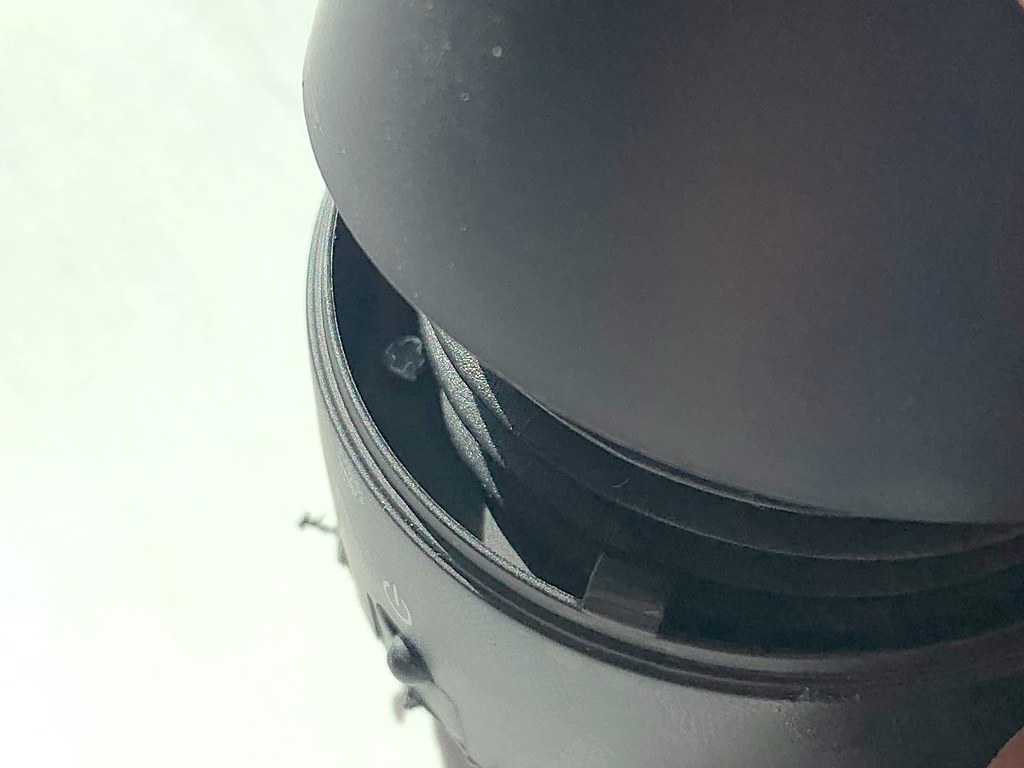
First thing to do, of course, is take them apart. See that little screw visible underneath the lid? There are three of those. I found it pretty easy to bend the lid out of the way and remove them all. With those out of the way, the bottom of the speaker popped off.
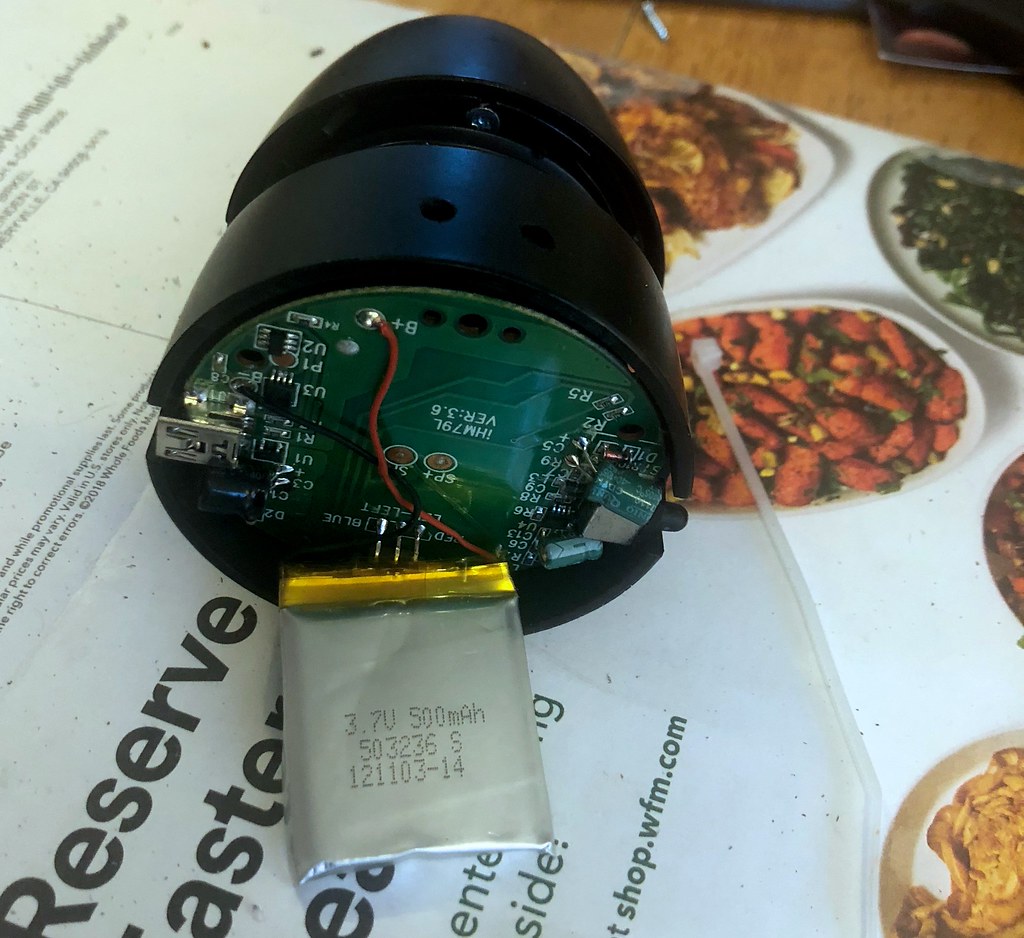
After drilling the holes; before installing the ziptie.
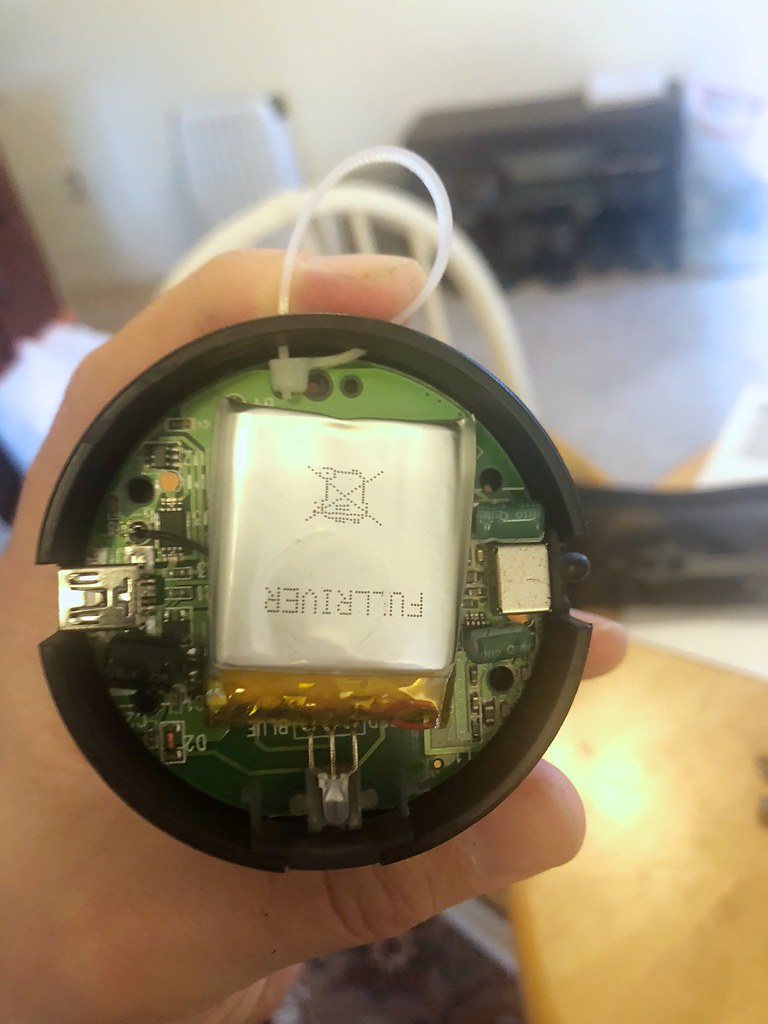
Powered by a standard 500mAh 3.7v LiOn battery pack.
There’s a little magnet glued inside the base that I pried out with a screwdriver to save some weight. The battery rests on top of the base inside the speaker, and with the base out of the way it falls out. I had to be careful not to yank the tiny wires that linked it to the circuit board.
By the way, if you want, you can swap out the rechargeable batteries at this point, and solder in some fresher ones. There are a variety of 500mAh 3.7v lithium batteries available via Amazon for example. It’s a pretty standard size.
I wanted to add loops to the sides of the speakers so I could hang them from hooks in a tent, so I got a little drill and made two holes in the side of the shell, just a little lower than the underside of the circuit board. (You can see them near the top of the photo.) Then I threaded a small ziptie through the holes, tightened it into a small loop, and clipped off the excess plastic.
With the ziptie in place, I stuck the battery on the base and pushed it back into the bottom of the shell. It only took a little bit of fiddling to get the ziptie on the right side of the plastic post inside. Then I put the screws back in.
But the fun wasn’t over yet! I also glued a Quad Lock adapter to the bottom of each speaker.
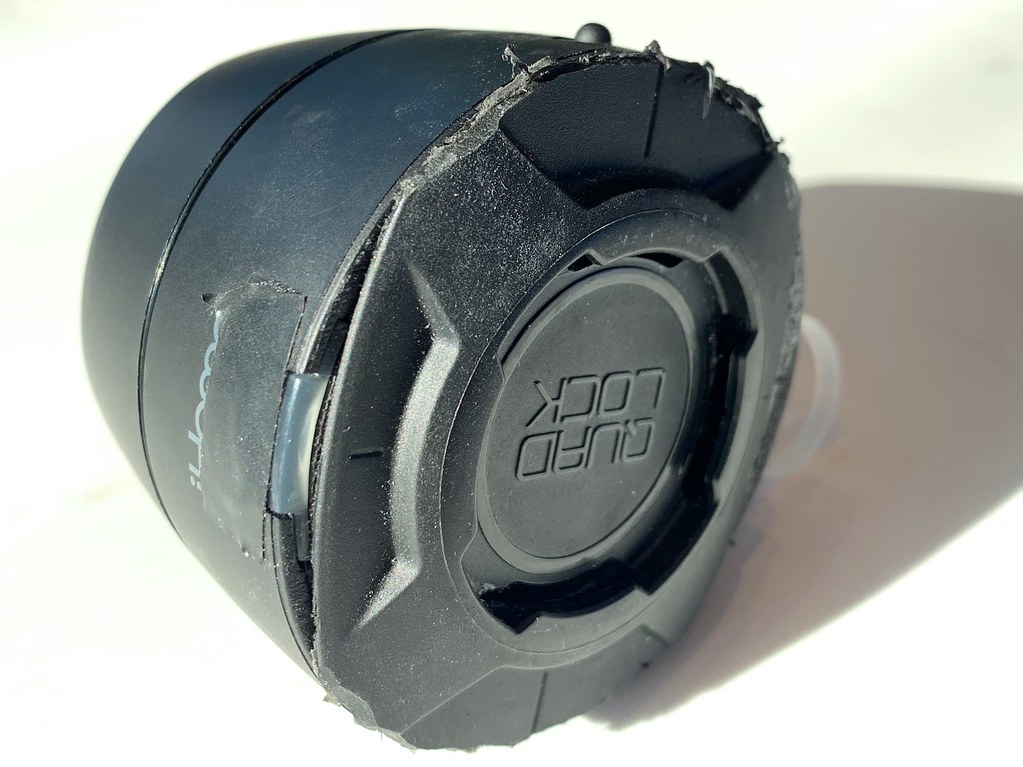
Now I could use the speakers with my laptop, or by my bedside, or on the ceiling of my tent, or on my bicycle! Huzzah! Here’s how they look:
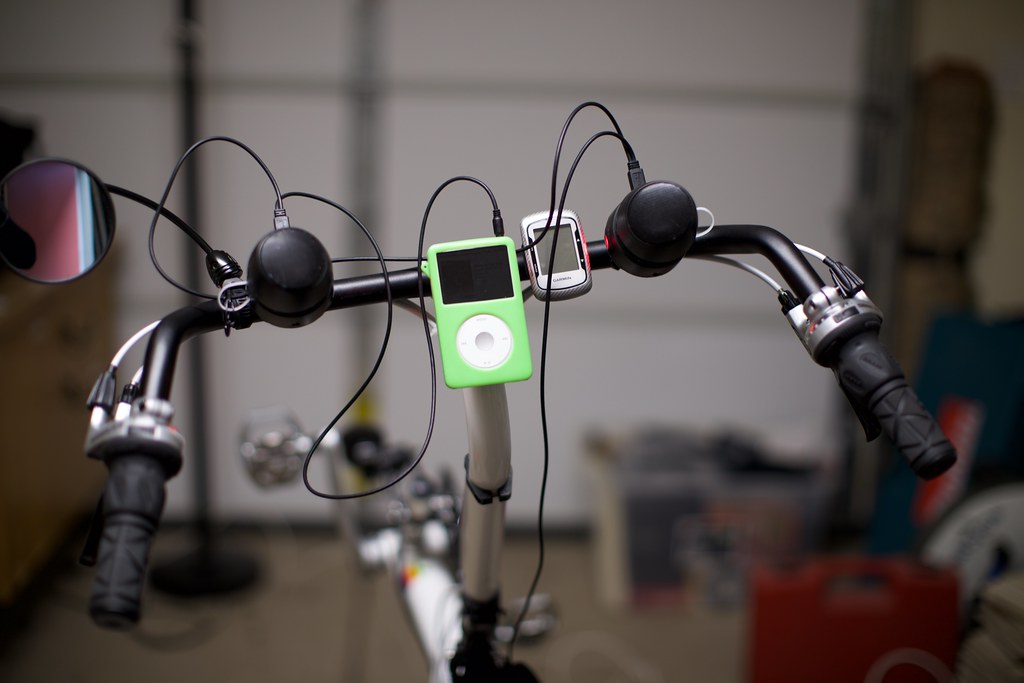
Ready for some sing-along riding!
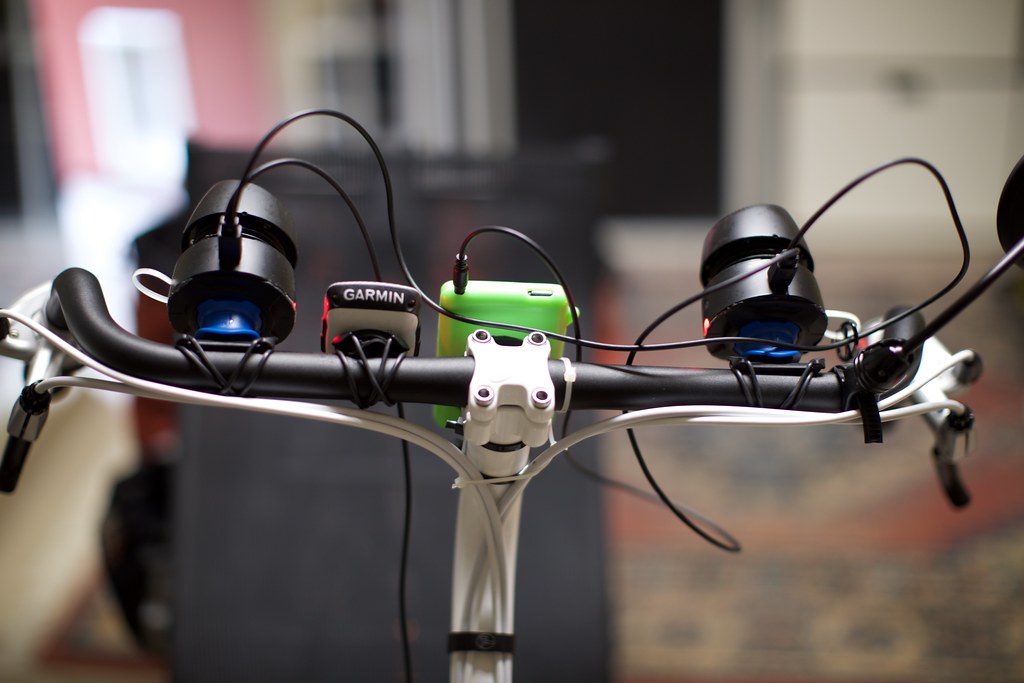
Perfect stereo for an audience of one ... and loud enough to irritate others too!
Yeah I guess the wires make it a little messy. But it sounds great!