Many graves have little patches of soil built into them, so you can grow flowers there instead of just placing them.
One of the postings on the message board was this depressing piece of advice:
Recommendation from Hjelmeland church council: Be careful not to use the small plastic grave lanterns. Birds steal them and carry them to pastures for livestock. Cattle and sheep can get internal injuries and in the worst case die if they ingest the remains of these grave lanterns.
Relative to the previous one about cartoon characters, the notice on the left is a lot more sensible:
How can you tell the difference between male and female birds? A) The male bird has larger wings B) The female bird only sits on the nest C) The male bird is more colorful
And on the right, some background on the farm by which Hjelmeland probably gets is name:
The Prestagarden
The Prestagarden (Roughly translated as Priest’s Farm), of which Hjelmen is a part, was probably originally called Hjelmeland. In the land register of the Stavanger diocese from 1620 it is called: “Prestegaarden ved Naffen Hjelmeland”. (Roughly translated as “Priest’s Farm at the base of Hjelmeland.”) The old farm name apparently became the name of the parish and later the entire municipality, while the farm has since been simply called Prestagarden.
Today the farm is closed, and the entire inland area is being developed as a city center area.
This division of plots has been going on since the end of the 19th century. In total, there are now between 60-70 fixed plots within the farm boundaries.
The village book for Hjelmeland can tell you a lot about the old farm, including the following:
“Summer work in the outfield by the farm became too scarce. The animals were therefore sent to Heggland to graze. There was no timber forest for the farm, only firewood. A lot of firewood was used in the big old parsonage. The Matriculation Commission mapped out 42 acres of fields and cultivated meadows on the farm in 1865. A large part of the hilly nature of 174 acres was used for cultivation. The hill cast so much shade that the sun disappeared for two months of the year.”
The Juniper Hills
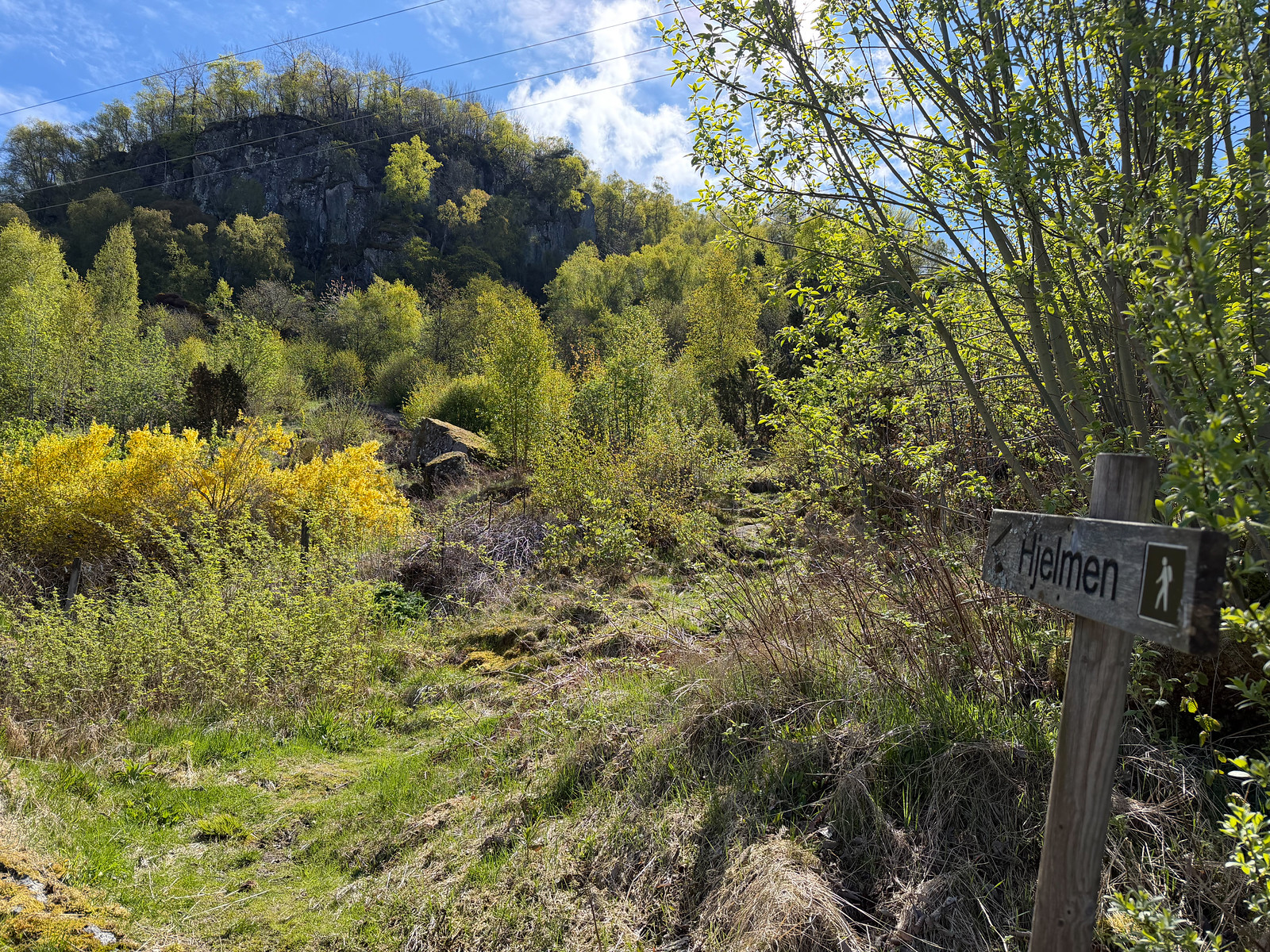
The area along the path from the field of the house and up to this noticeboard is old hay meadow and pasture land. Since there is no grazing pressure today, the hills are gradually being reclaimed by juniper, or “braje” as it is called locally. This is a typical feature. The juniper likes a lot of light, and forms beautiful columns. In pasture areas, it is still seen as a “weed”, as it can be a sign of overgrowth and decay.
Later, the juniper can be outcompeted by birch, as birch grows over it and blocks access to sunlight. This is happening at the top of Hjelmen.
Juniper is a hard and durable wood, which is used for fenceposts, among other things. Other uses are hook sticks, smoking fish and minor woodwork. The smell of clean juniper is good and distinctive.
Based on this notice, I’m near the end of a trail and walking slowly to the beginning, where it merges with the Hjelmeland suburbs, which used to be a farm.
The hills were alive with the dinky-dinky-dink sound of bells.
It was quiet enough that I could hear the individual bleats of sheep, but mostly what I heard was the “dink dink dink” sound of the bells they were wearing around their necks. It was a chorus of bells – at least 50 of them – at different volumes from all across my field of view, and I couldn’t remember hearing anything quite like it before.
I set the phone on a post and tried to make a recording, but since I had Airpods in, the phone defaulted to recording in lossy mono which ruined the effect. I didn’t realize it until I was back in the tent. Bah! Maybe I’ll encounter another horde of musical sheep later.
Escaflowne Corner, Episode 14
Right at the last few seconds of the previous episode, we got our “oh noez” cliffhanger, and this episode is all about those last few seconds, introducing a plot mechanic where if Van’s big stompy robot armor gets injured, he does too. We’re suddenly introduced to another character, and that character pulls some switch inside the robot, and instantly a WHOPPING HUGE SPACETIME HOLE opens right above our heroes and an enormous hook-shaped fortress factory thing descends. This development breaks a lot of rules and raises a ton of questions, but it looks cool, so why not.
After the robot is fixed, Van is suddenly healed, but now asshole rule-breaking strangely tomboyish general person is after him with his/her squadron of cannon fodder. Hitomi and the catgirl (hmm good name for a band) try to stop Van from fighting but that is definitely not going to work because — it would be boring! Van appears to be winning the hell out of the encounter, until the – ghosts? – of the cannon fodder soldiers he just cannoned through suddenly surround him and yank him into a new otherworld. (Different from the other otherworlds so far.) Again, breaking rules and raising questions, and this time I’m not convinced it looks cool.
Speaking as an old-ass adult, I enjoyed this episode. It had consequences and new information, a little bit of B-plot flavor, and – good lord – compared to previous episodes it was violent as hell, kind of beyond my expectations for a kids show. It also definitely feels like the kind of episode that would be right in the middle of an epic: Things get more and less complicated in equal measure, and we still don’t know where the story is headed overall.