I woke up from an unpleasant dream and realized my sleep apnea insert wasn’t placed correctly. The little sleep quality graph on my watch was mostly red lines. Drat!
The first decent mocha I’ve had in Paris. Thankfully not the last!
A work in bronze by a sculptor named Benoît Lucien Hercule. Died in poverty at the age of 65, in 1913.
I pedaled around in search of breakfast snacks and a change of working environment, and found a place about five blocks away that made a very chocolatey mocha and a good eggs Benedict, and seems to tolerate laptops.
When the mocha looks like mud, you know it’s gonna be good.
When the mocha looks like mud, you know it’s gonna be good.
It was still very crowded and not really a pleasant place to work, but the mocha was encouraging. The barista confessed “Sorry, we don’t know how to do it iced.”
I lingered just long enough to answer a few emails, then went back to the apartment so I could work in peace. Most of the afternoon was spent going over documentation and tweaking the “continuous integration” process for my project.
I have to admit, I didn’t really like the job. The project I inherited was over-designed and far too complicated for the needs of the company. Maintaining it was painful. I wanted to rewrite it in a much more compact form but was never granted the freedom. This kind of work is very exacting and highly abstract, and if you’re not really enthusiastic about the project you’re doing it for, you spent a lot of your work time fighting against your own brain, which is in a state of constant rebellion. (Like Paris.)
Nevertheless I did battle for about five hours, then went on another ride to clear my head.
Don’t walk under the ladder propped in front of the Lucky Bastard Cafe. It’ll just confuse things.
While heading out of the apartment, I listened to a “Sawbones” podcast episode about Hepatitis C. Disease exposure was on my mind with the pressing crowds of Paris. Of course, for the rest of the day I obsessed over whether everyone I met had Hepatitis C…
Just a few blocks over I found a café that made an “iced mochaccino”. Will it stand up to my absurd mocha rating scale? We shall see! (Spoiler alert: No. It scored a 5 out of 10.)
I ordered tiramisu and it was totally different from what I got in Brussels, but still quite good. Also different from what I got anywhere in America. I should have expected this, really.
After scarfing that down I joined a work meeting with four other people in it, and listened with my earphones while I walked the half mile back to the apartment. A weird new first: Participating in a work meeting while strolling around in Paris with my phone, headphones, and some keys as my only equipment. I’m too old to be a yuppie, so I guess I’m an “uppie”.
Théatre du Caveau de la République has an adorable mascot! Some kind of buck-toothed pixie??
Back at the apartment I wrote code for several hours, then did some documentation, and then the rest of the day was mine. I set out again for food, choosing to stay on foot for a change instead of using the bicycle.
I randomly chose a restaurant, and sat down at the usual microscopic outdoor table. Dinner was a Caesar salad which was way too dry and some “fresh squeezed’ orange juice that definitely tasted as though it sat around all day. As I finished it, I almost laughed at the thought: “Hey, it’s my first unacceptable meal in Paris! A new milestone has been reached!”
As I dined, and later on as I walked slowly around the city in the evening gloom, I listened to some of “A Distant Mirror“. This was going to be a favorite of mine for the rest of the Paris visit. While contemplating stone walls, canals, and random strangers, I heard about the arrest and torture of the Knights Templar, who were basically yet another pointless aristocracy that ran afoul of the church and were devoured by it. Their head honcho was burned alive right in front of Notre Dame (like so many, many others, especially later when witch trials began.) Earlier in the week I’d passed by the very spot on my bike.
I also heard about the 13th-century expulsion of Jews from France, and how they were scapegoated as “money lenders” specifically by the church, which considered the lending of money “unclean” but was forced to admit it was a necessary part of large-scale commerce, so they mandated that role to Jews to deliberately enflame their status as “unclean”. All dictators need a scapegoat and a war, and the church was no exception. Tale as old as time.
Back at the apartment I went down a completely different digital rabbit hole, reading about old computer games from my adolescence that I’d missed out on because they were distributed only in other countries. I ran into a game called “Princess Maker“. Weird. And weirdly compelling.
It is what it sounds like — sort of. You guide a young lady through her adolescence by setting her work, school, and travel schedule. You don’t control her directly, or even interact with her directly. The majority of the interaction consists of picking menu items. If you get her stats and reputation high enough, she becomes queen of the land. Lesser outcomes include “housewife”, “con artist”, and “wandering wizard”.
There’s a framing device where you – the player – are described as a heroic knight that saved the kingdom from an invasion, and as a reward you asked to start an orphanage. I assume the framing device is there to give male players a more comfortable angle to participate: Consider it practice for being a Dad? (Well, as long as being a Dad consists of picking menu items with a mouse.) It’s the attitude that counts I suppose.
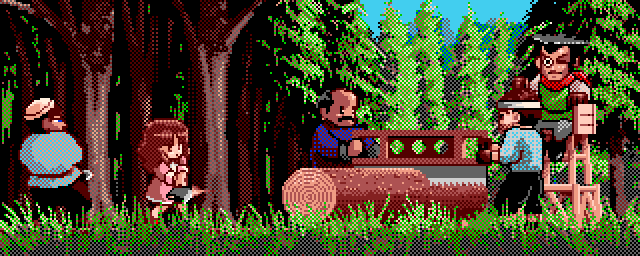
Your princess-to-be, chopping a tree down with some lumberjacks as an extracurricular activity.
Hey whaddaya know, there’s a PC-98 emulator for MacOS called “DosBox-x“, and some usage directions. An interesting rabbit hole. I felt a bit too lazy to actually play the game, but it got my mind churning about cultural differences again. When I was a boy growing up in California, role models of men spending their time raising children were pretty thin on the ground. You could join the army, fight crime, be a really good dancer or singer, kick ass at some sport, or perhaps be one of those interesting and windswept loner types, but being a Dad? Maybe you could be a “sitcom dad” like Tim Taylor and dispense some life lessons, but it was mixed in with acting like an idiot half the time.
Perhaps this is why I always felt a kinship with Scrooge McDuck, who spent half an hour each weekday living an adventurous life but also taking care of three nephews at the same time.
Today I sat in the restaurant where Amelie was filmed, and listened to music and a series of podcasts about Russia, and then a book about French history.
It was well weird comparing the current and former state of both countries, and asking the question that’s on a lot of minds this year: Can Russia ever change away from fascism and still remain Russia?
One of the people I listened to was Mikhail Shishkin, speaking as a guest on an Intelligence Squared podcast episode, titled “Is Russia Doomed By Its History?” He made a very sobering point: People who live in a fascist state, and do not oppose it, do not see themselves as fascists, and when their state attempts to bring fascism to a neighboring state through subjugation (e.g. war) they see themselves as liberators, rather than conquerors or subjugators. Since fascism is what they know and believe in, inter-state conflicts are not a matter of freedom versus subjugation, but a matter of a big fish eating a smaller fish. It’s kill or be killed in a zero-sum game, because there couldn’t possibly be a form of governance they could switch to that would move them even a little bit out from under the bootheel of the criminals at the top.
Want to escape from that restaurant in Amelie? Here’s how.
Besides, if you live in fear of your ruling party, then what better way to distract them from plundering you than encouraging them to plunder someone else?
Just so with the Russian people, over the last 100 years, inside and outside the USSR.
Anyway, I ate two lunches at the cafe, since I’d skipped breakfast and intended to skip dinner: A caesar salad with ham, and a rich avocado toast with salmon on top. As one should on a proper vacation, I ate slowly!
Lots of people came in to take photos of the place, giggle a bit, and then dash right out again. So to be a contrarian, I left without taking a photo of the interior. If it ever came up, I could certainly remember that I’d dined in the restaurant used in the film. I wouldn’t go scrambling for photographic proof of it and no one would ask. What, would they accuse me of being a liar? Maybe when I was 16 years old and boasting in a schoolyard. Not now. At the same time, that photo isn’t something I’d put on my wall or even in a screensaver. Most of my keepsakes are either highly portable digital items, or living things walking around looking after each other.
I followed this train of thought as I rode the bike over to the Cimetière de Montmartre. Alas, it was closed for the day…
Hmm, Montmartre cemetery closes at 6pm. Good to know. I’ll have to come back later…
I still remember the time when film was expensive and photographs were prized artifacts from an otherwise obscure and unseen era. That’s so thoroughly not the case now. And now we’re making our way into a realm where photographic evidence is no longer evidence of anything in particular, given that you can ask a computer to bake you an image of yourself doing whatever you can describe, in any place you can name. So what is the point of taking a photo when you do go there?
Maybe now you can start to relax and just be. You can even take the photo retroactively if the need arises.
It seems like a matter of time before we’re all wearing gadgets that take – or gather – photos of us everywhere by default. I’m imagining high-quality cameras all over the place that are not just used for city surveillance by the police, but made available to our phones (or whatever the gadget is), so when we want – if we want – we can just gather up dozens of photos of ourselves taken by these devices and aggregate them. You can imagine a camera on a stick planted in front of every scenic vista, constantly recording. People will embrace the implied total surveillance because of the convenience of sending a “selfie” to their friends and social media without even needing to reach into a pocket.
Roll that forward two or three decades, and we will not be carrying anything around at all, yet still able to gather photos of ourselves afterwards, interact with our personal digital worlds by talking to lampposts (since our voice and face is our password), pay with our fingerprint or our face, access transcripts of everything we’ve said, and so on. People will embrace total surveillance and recording because it will be fun. They’ll get to buy into it. And the old saying, “if you have nothing to hide, you have nothing to fear” will sound so very reasonable… That’s what they said in the USSR, as they dumped radioactive waste straight into the river…
I loathe this future.
The opportunities for exploitation will be practically infinite, and practically invisible. And as I get up and walk out into the seething crowd of tourists on this street, I’m asking myself a really frightening question:
At what point does a state become so exploitative – and skilled at crushing dissent through social manipulation and surveillance – that the people trapped permanently at the bottom of it have no other choice but to take up arms and start physically smashing the apparatus? Are we heading towards a level of lock-in through technological advancement so high that the ONLY way out is to beat down doors and set fire to mansions? Are we headed for another French Revolution, but on a global scale, with the attendant scale of death and chaos?
Huh. So that’s where it is. No desire to go inside currently, but, good to know.
Huh. So that’s where it is. No desire to go inside currently, but, good to know.
‘Cause you know, at some point, the food’s going to get too expensive even with fertilizer, and the water is going to get too expensive to clean, and the digital apparatus is going to be tightened and tweaked so that the wealthy keep eating, while the rabble drowns in poison.
An ex of mine (who shall remain nameless because she was rather unkind) once said, “Being in Paris consists of a lot of ‘seeing of beauty.'” Since this was my first non-work day in the city, it was time to go do some of that!
I stripped all my luggage off the bike, leaving one bag with the camera in it. Everything else could stay locked behind this insane apartment door:
I got a recommendation from friend Cara to try the hot chocolate at Angelina. It looked amazing but there was an equally amazing line, and the wait for a table was 70 minutes. So I hopped across the street to Tuileries Garden, and did some “seeing of beauty” instead.
This park is rather long. Note the tourist dragging his suitcase. Common thing: Pack up to leave your hotel room, then roll around for the day until you get on a train in the evening.
This park is rather long. Note the tourist dragging his suitcase. Common thing: Pack up to leave your hotel room, then roll around for the day until you get on a train in the evening.
I wandered the gardens with my “courtyard” playlist adding to the atmosphere — mostly stuff by Harold Budd and Stephan Micus, with the Coil album “The Agelic Conversation” mixed in.
I passed two large fountains ringed with chairs, and every chair was occupied, with crowds milling around them. There were at least three cafes partially under shade, and each had a line about 20 people deep. It was more like being in the middle of a farmers market than being in a park. Perhaps it’s some kind of post-COVID travel boom, but it really feels excessive, like, how do the actual residents of Paris even put up with this?
I also saw people – I couldn’t tell if they were locals or tourists – sitting with their feet deliberately across a second chair just to get a little more comfortable, even though literally hundreds of people, including elderly, were all around them and any one of them would have probably sat down given the chance. I was thinking, “Is this Parisians saying ‘screw you’ to the tourists, or is this tourists saying ‘screw you’ to each other? Maybe both…”
When I reached the other side, it was time to launch myself into the streets again to find that big pokey-uppey thing everyone’s heard about:
Cool! Now if someone dares me to prove that I’ve seen the pokey-uppey thing, I can show them this picture, which looks totally fake and exactly like all the other ones. MISSION ACCOMPLISHED!
Meandering back to the north, I encountered a protest in progress.
This is a march about … Hmm. About apparent side-effects from the COVID-19 vaccine? What?
Several people were carrying anti-COVID-vaccine signs, but they were mixed with others I couldn’t parse. To be honest, I wasn’t sure what the protest was about. But it was very French.
After that, I found some more buildings to stand in front of:
Whoever’s buried here must be, like, important and stuff!
Whenever I step out, I bring an angel along to keep my drapes from falling off.
Some time after that I saw this poster on a wall, and was intrigued. With a little help from my phone I realized it was a concert happening the very next day, and I could still buy a ticket for it.
Back in 1992 I was gifted a CD with Mozart’s Requiem, and I played the heck out of it. It fed into my lifelong obsession with music. It’s one of the most popular pieces of “classical” music in the world, and for good reason.
I paused my random bicycling to eat another decadent snack, and try to buy a ticket with my phone. The interface was just a little bit broken. Perhaps that’s why there were still tickets!
I was starting to run out of daylight, but there was one more garden I could visit on my way to the apartment: Place des Vosges, the oldest planned square in Paris, commissioned by Henri IV in 1612.
When you’re pressed for time because there are so many things to see, and one of those places is a gorgeous park that’s been sitting around being gorgeous for 400 years, and one of the best ways to enjoy a park is to stretch out and read a book for the whole afternoon, but it’s already evening, what can you do?
All I could do was stroll around and take a few photos, and imagine that I’d been lounging on the grass all day.
I heard Nick leaving in the middle of the night, to catch his flight down to Portugal. The bike would be staying here until our paths crossed again in a few weeks for the journey to Edinburgh.
I fell back asleep and brought my total to 7 hours. Not bad. When I sat up and realized the sink and bathroom were up two sets of stairs, I decided I would sleep in the little upstairs room for the rest of my stay. I didn’t need all this mattress.
I took my first shower, and discovered that the bathtub was made of plastic and not anchored to the floor, so it tipped alarmingly when I reached for a towel. The curtain didn’t go all the way around, so the floor got wet. That was fine because the floor was a shower stall: The drain of the bathtub went into a hose, which went into a shower drain in the corner.
Why does this AirBnB have so many plants to take care of?
A plastic tub shoved into the shower stall. Classy.
It was pretty funny. I’d been in some really janky places all over America, and yet I’d never used a setup this janky. Even the bare cement showers in RV parks usually compensated for their brutalist vibe by being spacious. It was a fact I would be learning repeatedly: Physical space is clearly the most expensive commodity in Paris.
I also noticed a sign by the dishwasher that I’d never seen before, even in the most uptight AirBnB units of Iceland or New Zealand:
Why leave high-maintenance silverware in a flat you’re renting out to people on a daily basis? This makes no sense.
Why leave high-maintenance silverware in a flat you’re renting out to people on a daily basis? This makes no sense.
This little apartment generates something like five grand a month for these people. What do they care if the silverware gets tarnished? Shouldn’t grandma’s fine utensils be somewhere else?
I shrugged. It’s not like I would be doing any cooking in this place more elaborate than heating up bread. Time to go see the city!
I rode directly down to Ten Belles, since it was on my “must try” list, but it was exploding with people. There was one tiny free table and a long line out the door. I picked streets at random and wound up near the canal again. On the other side was a café named “Residence Kann” that looked interesting, and not too crowded. They advertised a “mochacchino,” which turned out to be a lot like the mocha from Bluebottle back home. Very foamy and smooth, but with enough chocolate to make it a “real” mocha.
I decided I would eat at a different café at least once every day, and always order a mocha or the closest equivalent, so I could rank them all against my very severe and subjective 1 to 10 Worldwide Mocha Ranking Scale. “Residence Kann” got a respectable 7.5! They also served avocado toast, which is catnip to us middle-class wankers, so I got some.
This was the first place where I saw little signs on the tables indicating “no laptops”. I hadn’t seen any Parisians with laptops anywhere yet, so perhaps this was a city-wide custom and the signs are for the crude tourists (like me) to get a clue.
Computers are TOLERATED for a certain time. Otherwise, we Parisians hate you remote-working yahoos. Get out!
I wondered if it’s also considered insulting to the waitstaff to be sitting there doing the thing that makes you a much higher wage than they do, while they bring you food and wipe up your crumbs. But surely being a waiter in Paris earns a good wage?
Also, I wondered if a similar anti-laptop rebellion was coming to San Francisco and New York… If it wasn’t rolling in already. Back home I wasn’t seeing “no laptop” signs directly on tables yet, though I was seeing polite signs on walls asking that people limit their computer time to an hour or so. Maybe the Bay Area is too aware that people on laptops account for at least half the money being made there, and no one wants to upset them…?
Well, the cafe is nice even if they don’t like laptop users.
Well, the cafe is nice even if they don’t like laptop users.
I sipped my drink and felt fancy, and tried to conjure up a first impression of Paris, or at least this region of it. It was far more cramped and busy than I was expecting. The press of people was constant, and could easily get overwhelming. The importance of open spaces like the canals and gardens felt very clear to me.
I remembered reading somewhere that people often experience a kind of emotional shock, some time in the first few days, when they realize that the Paris they’re walking around is extremely different from the Paris they imagined. A depression sets in; what one might even call … ennui, and it lingers until they surrender, and adapt to the city on its own terms. Perhaps I was due for that kind of emotional journey in a few days.
I did a little reading, and learned some statistics:
2 million people live in the city of Paris. Somewhere between 7 and 13 million people live in the “metropolitan area” of Paris, depending on how you slice it. 68 million people live in all of France. So, as much as one fifth of all French people live in or around Paris. That’s a massively influential city.
For comparison: 8.5 million people live in the city of New York, while the entire state of New York has 20 million people in it. So if you’re “a New Yorker”, one third of the time that means you’re living in the city itself. This assumption by outsiders is so strong that people have to say they’re from “New York state”, just to make it clear that they’re not living in the city. Along the same lines, it would be plausible to change the name of Paris to “France City,” because when travelers think of France, they think of Paris. Meanwhile, four fifths of French people would have to start pointing out that they’re from “France THE COUNTRY, you dang tourist! Don’t lump me in with those urban jerks!”
I’m sure they would love that…
What’s intriguing to me is that, bustling as it is, Paris used to be much more populated, until the mid-20th-century when huge amounts of people migrated outward due to enhancements in rail and auto travel, and created massive suburbs. Only in the tail end of the 20th century has the population begun to move inward again.
I took a scroll through the history of Paris, and found an epic of war and revolution going back many hundreds of years, casting a long shadow, even over the World Wars. It was one bloody synthesis of king and church after another for 800 years until the French Revolution, then a bloody sequel in the form of the Napoleonic empire, then a confusing run of coup d’états and collapsed governments, with modern reforms and counter-reforms beginning some time after World War II and continuing through the century.
Thinking about this, and based on what I was seeing Parisians do around me just with regard to things like crosswalks, public gatherings, demonstrations, and trespassing, I concluded that the French must have a strong sense of independence from their government, and the laws and order it tries to impose. It’s truly an inspiration for the American attitude that if a law does not promote the common good, the law should be changed. Or in the case of Parisians, the law should be ignored, because the whole damn government is suspect, and may be collapsing some time in the near future anyway.
While I was musing over this, I had an interesting side-thought: Many of my fellow Americans have a strong aversion to talking about “politics” in public, or even in private when they’re not among friends. I suddenly had two questions about that. First: Why this aversion? And second: What does it even mean, to separate “politics” as a subject out from everything else?
As I packed up my stuff in the café and headed for my bike and another random ride around the city, I tried to conjure a few answers.
I figured that Americans try to avoid “politics” because it can cause friction among people who would otherwise just get along with the business of economic exchange, and relating to each other in their immediate context, e.g. at a baseball game or while standing in line at a supermarket. And Americans want to get business done, because they want to survive.
Put another way: There’s a subconscious feeling that peaceful coexistence with neighbors who disagree with you is more important than agreeing on how your government should be run, because you and your neighbor are right here face-to-face, and the government is way over there, potentially in another state, potentially thousands of miles away. This feeling might actually be the reason America still exists as a single country at this point. But what is this “politics” that people are so averse to discussing? My take was, it seems to be something encompassed by “policy” but actually more specific: “Politics” to the American seems to be about the people in government, and the political parties they belong to, and what those people and parties are like, or what they endorse.
For example, the regulation of America’s border with Mexico is certainly a political subject, and people will discuss that – cautiously – while considering details like our shared sense of responsibility to take in refugees, our collective status as a nation of migrants, our desire for respect of the rule of law, and our desire to prevent human trafficking and the movement of narcotics. But, statements like “The Democrats want lawless chaos instead of a border!” or “The Republicans want to separate migrant babies from parents!” … That’s what we call “politics.”
There are a lot of Americans talking “politics” online, on television, on radio… But there are also a lot more Americans who find it aggravating and would rather talk policy. Sadly, those discussions don’t drive mouse-clicks, finger-pokes, and ad revenue dollars, so it’s easy to get confused about whether they exist at all. At the same time, a lot of Americans have the luxury of not engaging with politics – or even policy – at all, because they do not belong to one of the sub-groups that the law is currently victimizing in some way. E.g. migrants, users of illegal drugs, pregnant women looking for medical care, people with non-Christian religious practices, and so on. So from one perspective, these people create stability, which is great … but from another, they create complacency, which is infuriating … and they need to be reached and told what their tax dollars are doing to other people.
Well, that was my quick packing-the-bike take on it, anyway. Next stop: Caféinoman, for a “detox juice blend” and a muffin. (I couldn’t handle any more coffee.) They were both pretty good!
Looking around, I got the sense that most of the dozen-or-so people in the café were fellow tourists. I wondered if I would ever get a clear picture of what Parisians are like, separate from tourists. Probably not. I mean, if you took all the bacteria out of a human body – benevolent or otherwise – would that give you a “clear picture” of the immune system?
Browsing the map, I decided to check out “Jules Verne Park,” because it sounded cool. I dropped my muffin in the street as I was riding along. Dangit! Well, food for the rats I guess.
“Jules Verne Park” turned out to be a kid’s play park, packed full of tiny humans and larger humans chasing them or sitting around looking exhausted. Not what I was hoping for. The noise made me crave a quiet space, so I rode back to the apartment, and used the remaining hour before my first work meeting to sort photos.
Three hours later the meetings were done and I’d written everything useful into a page of notes, so I walked around the corner to the café Nick and I had gone to, and ordered their all-day brunch. I chatted with folks on the phone and did more snacking – what a life I lead! – then strolled to the apartment and pitched myself into the upstairs bed. My brain was full of French history, computer code, and the roar of a thousand conversations that had pressed in around me all day.
Would this be the Paris routine for me? Cafés, history, parks, work, and bicycling? If so, I’ll take it!